The New Dialogue: Conversational AI as Your Personal Expert
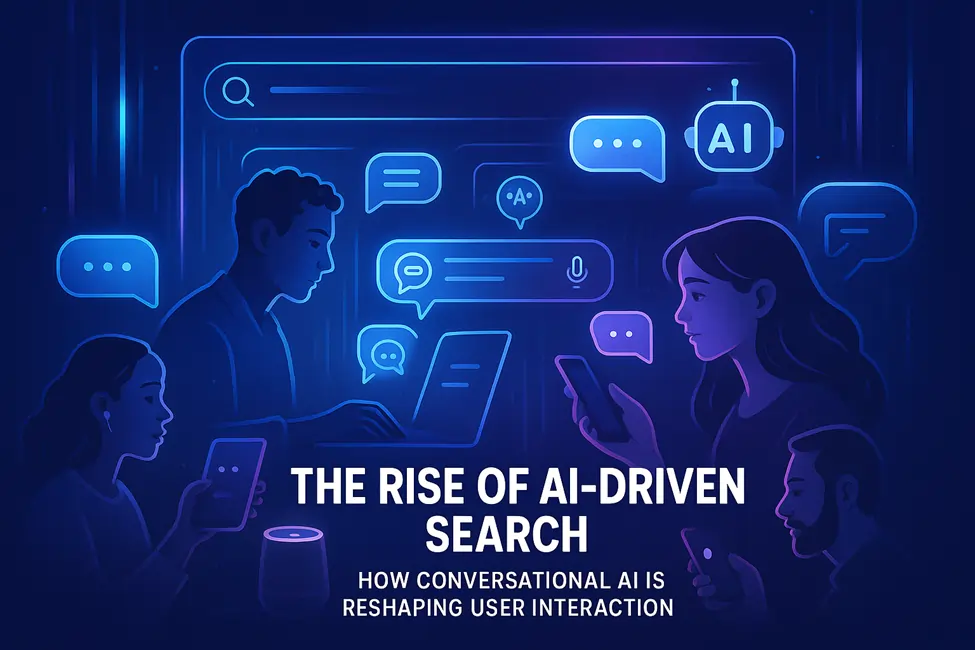
Do you remember how you used to search for things online? You’d type a few keywords into a search box, hit 'Enter', and get a list of ten blue links. You would then connect through them, one by one, piecing together the information you needed. For years, this was the undisputed way we found answers.
Now, think about how you might do it today. You pull out your phone and ask, "Where can I find a good restaurant in Khan Market that serves authentic butter chicken and is open after 11 PM?" Instead of a list of links, you get a direct, synthesized answer, perhaps with a map, a top recommendation, and even a summary of reviews.
This isn't a scene from a sci-fi movie; it's the reality of AI-driven search, and it's happening right now with tools like Google's AI Overviews, ChatGPT, and Microsoft Copilot. We are no longer just "searching"; we are having conversations with intelligent engines. This is the most profound shift in user interaction since the dawn of the internet, and it's fundamentally changing the digital landscape for businesses in India and across the globe
This new world requires a new strategy, one that goes beyond keywords and rankings. It's called Generative Engine Optimization (GEO). At Public Media Solution, we're here to guide you through this transformation, explaining how conversational AI is reshaping customer behaviour and what you need to do to ensure your brand not only survives but thrives.
The Old Model: A Monologue of Keywords and Clicks
For the better part of two decades, online visibility was a one-way street.
- A user had a need and translated it into a few keywords (e.g., "best SEO company Delhi").
- A search engine matched these keywords to its index and returned a list of relevant webpages (the Search Engine Results Page, or SERP).
- The business's goal was to perform well in this ranking competition through traditional Search Engine Optimization (SEO) to earn a click and bring the user to their website.
The interaction was transactional and impersonal. The search engine was a silent librarian, suggesting you to the correct aisle but leaving you to read the books yourself.
The New Dialogue: Conversational AI as Your Personal Expert
AI-driven search has torn up that old rulebook. The interaction is no longer a monologue but a dynamic, interactive dialogue.
Conversational AI understands language, context, and intent in a way that was earlier impossible. Users are no longer forced to think like a computer; they can ask questions naturally, as if they were talking to a human expert. The AI engine, in turn, doesn't just point to sources; it acts as a research assistant, reading multiple webpages, synthesizing the key information, and presenting a single, coherent answer.
This leads to a phenomenon that is rapidly growing: the "zero-click search." Users get their answers instantly on the results page, often feeling no need to click through to any website at all. If your brand isn't mentioned or cited in that AI-generated summary, you are, for all practical purposes, invisible.
How Conversational AI is Fundamentally Reshaping User Expectations
This shift from a list of links to a direct conversation is rewiring what customers expect from their online experience. Understanding these new expectations is the first step to meeting them.
1. The Expectation of Immediacy and Directness
Users now expect instant gratification. They don't want a reading list; they want a direct answer. The AI does the heavy lifting of sifting through information, and users have quickly grown accustomed to this convenience. Patience for clicking through multiple links to find a simple fact is wearing thin.
2. The Expectation of Context and Personalization
Conversational AI can remember the context of a discussion. You can ask a follow-up question without restating the actual topic, and the AI will understand. This creates a personalized journey where the search experience feels tailored to the individual's specific needs. Users expect the engine to comprehend their nuanced intent, not just their keywords.
3. The Expectation of Unquestionable Trust
When an AI engine presents a synthesized answer, it carries an implicit seal of approval. Users tend to trust this curated information, placing the burden of accuracy squarely on the brands and sources the AI chooses to cite. A brand's reputation is no longer just about what it says on its own website, but about how it is perceived and represented by these strong AI gatekeepers.
4. The Expectation of Multimodal Answers
The conversation is not limited to text. AI can pull in images, videos, charts, and product carousels to create a rich, multi-format answer. Users now expect answers that are not only informative but also visually engaging and easy to digest.
GEO: The Strategy for Winning the AI Conversation
If the new digital marketplace is a conversation, Generative Engine Optimization (GEO) is the art of making your brand the most compelling and trustworthy voice in that conversation.
GEO is the practice of structuring your brand's information, content, and online presence in a way that makes it easy for AI models to understand, trust, and cite you in their generated answers. The goal is no longer just to rank a page; the goal is to become a source of truth that the AI relies on. This means shifting your focus from optimizing for search crawlers to optimizing for the complex Large Language Models (LLMs) that power these new engines.
How to Optimize for Conversational AI: Your GEO Playbook
So, how do you ensure your business is the one the AI turns to for answers? It comes down to four key pillars of GEO.
Pillar 1: Write for Questions, Not Just Keywords
AI thinks in terms of questions and answers, so your content must do the same.
- Adopt a Q&A Format: Structure your content with clear headings that ask the very questions your customers are asking. FAQ pages are now more powerful than ever.
- Embrace Conversational Language: Write like a human speaks. Focus on long-tail keywords and natural phrases that capture the user's true intent (e.g., "how to get a home loan in India with no credit history").
- Answer First, Explain Later: Provide a clear, concise answer to the main question at the very beginning of your article. You can then use the rest of the content to provide depth and detail.
Pillar 2: Build Unshakeable Trust with E-E-A-T
For an AI to cite you, it must trust you. Google's E-E-A-T framework is the blueprint for creating this trust.
- Experience: Don't just tell, show. Share real-world case studies, first-hand product reviews, and practical examples that prove you've actually done what you're talking about.
- Expertise: Showcase your credentials. Feature detailed author bios, link to professional profiles, and cite traditional sources to back up your claims.
- Authoritativeness: Become the acknowledged expert in your niche. Earn mentions on reputable industry websites, news articles, and even community forums where relevant discussions are happening.
- Trustworthiness: Be transparent. Ensure your website has clear contact information, privacy guidelines, and that your content is factually accurate and regularly updated.
Pillar 3: Speak the AI's Native Language with Structured Data
Structured data, or Schema Markup, is like counting labels to your website's content that AI can read perfectly. It's the most direct way to tell an AI, "This is our business address," "This is a product review," or "This is a question with its answer".
- Implement Key Schema Types: Focus on schema like FAQPage, LocalBusiness, Article, and Product to give AI clear, unambiguous information that it can easily pull into its answers. Using schema is no longer optional; it's essential for visibility in the AI era.
Pillar 4: Become a Recognizable “Entity”
AI engines see the world as a collection of "entities"—real-world people, places, and things—and the relationships between them. Your business needs to be a clearly defined entity in the AI's "brain," which is primarily built on Google's Knowledge Graph.
- Master Your Google Business Profile: This is your official business identity for Google. Fill it out completely and keep it updated.
- Ensure Consistency: Your Name, Address, and Phone number (NAP) must be identical across your website, social media, and all online directories.
- Get Listed: Establish your entity by creating profiles on platforms like Wikidata, LinkedIn, and relevant Indian business directories.
The Conversational AI Opportunity for Indian Businesses
This new era of search presents a unique opportunity for businesses in India.
- Hyper-Local Dominance: Conversational AI excels at understanding local intent. Businesses that optimize for specific cities, neighbourhoods, and local landmarks can capture highly relevant "near me" searches.
- The Power of Vernacular: As AI becomes more fluent in India's diverse languages, creating high-quality content in regional languages is a powerful way to connect with a massive, underserved audience.
- Mobile-First Advantage: With the majority of Indians accessing the internet on mobile devices, the conversational, app-like interface of AI search is a natural fit. A fast, mobile-optimized experience is critical.
- Expertise Over Size: GEO levels the playing field. A small, specialized business with deep, authentic expertise can now gain more visibility in AI answers than a large, generic competitor.
The Future of Search is a Conversation
The shift from a search bar to a chat window is more than a change in interface; it's a change in the very nature of how we interact with information. We are moving from a world of seeing links to a world of receiving answers.
This is not the death of SEO, but its necessary and exciting evolution. Generative Engine Optimization is the framework for this new reality. By focusing on conversational content, building in-depth trust, structuring your data for AI, and establishing your brand as a credible entity, you can ensure your business is not just a participant in this new digital dialogue, but a leading voice.
The future of customer engagement is here, and it's conversational. Let's make sure it's talking about you.
Ready to adapt your strategy for the age of conversational AI? Contact Public Media Solution today, and let's build your brand's authority for the future of search.
Frequently Asked Questions (FAQs)
Q1: Is conversational AI just a short-term trend?
No, all signs point to conversational AI being the future of how people interact with technology and find information. It represents a fundamental shift toward more natural, human-like digital knowledge, and it is here to stay.
Q2: How can I track my success in conversational AI search?
Traditional metrics like keyword rankings are less relevant. For GEO, you should track metrics like "source rate" (how often your brand is mentioned in AI answers), your "AI Share of Voice" (your visibility compared to competitors), and referral traffic from AI platforms.
Q3: Is GEO only for big companies with large budgets?
Absolutely not. GEO creates a massive opportunity for small and medium-sized businesses. AI engines prioritize the quality and trustworthiness of the answer, allowing niche experts to compete with larger players based on the strength of their knowledge, not the size of their marketing budget.
Q4: How is this different from optimizing for voice search?
It's very similar and the strategies are highly complementary. Both voice search and conversational AI rely on natural language, long-tail questions, and the need for direct, concise answers. A strong GEO strategy will almost always improve your performance in voice search.
Q5: What is the best first step to start optimizing for conversational AI?
Start by deeply understanding the questions your customers are asking. Create a comprehensive FAQ page on your website that answers these questions directly. Alongside this, fully optimize your Google Business Profile, as this is a primary source of information for Google's AI.