Best AI SEO Tools in 2026: What Actually Works for Search and GEO
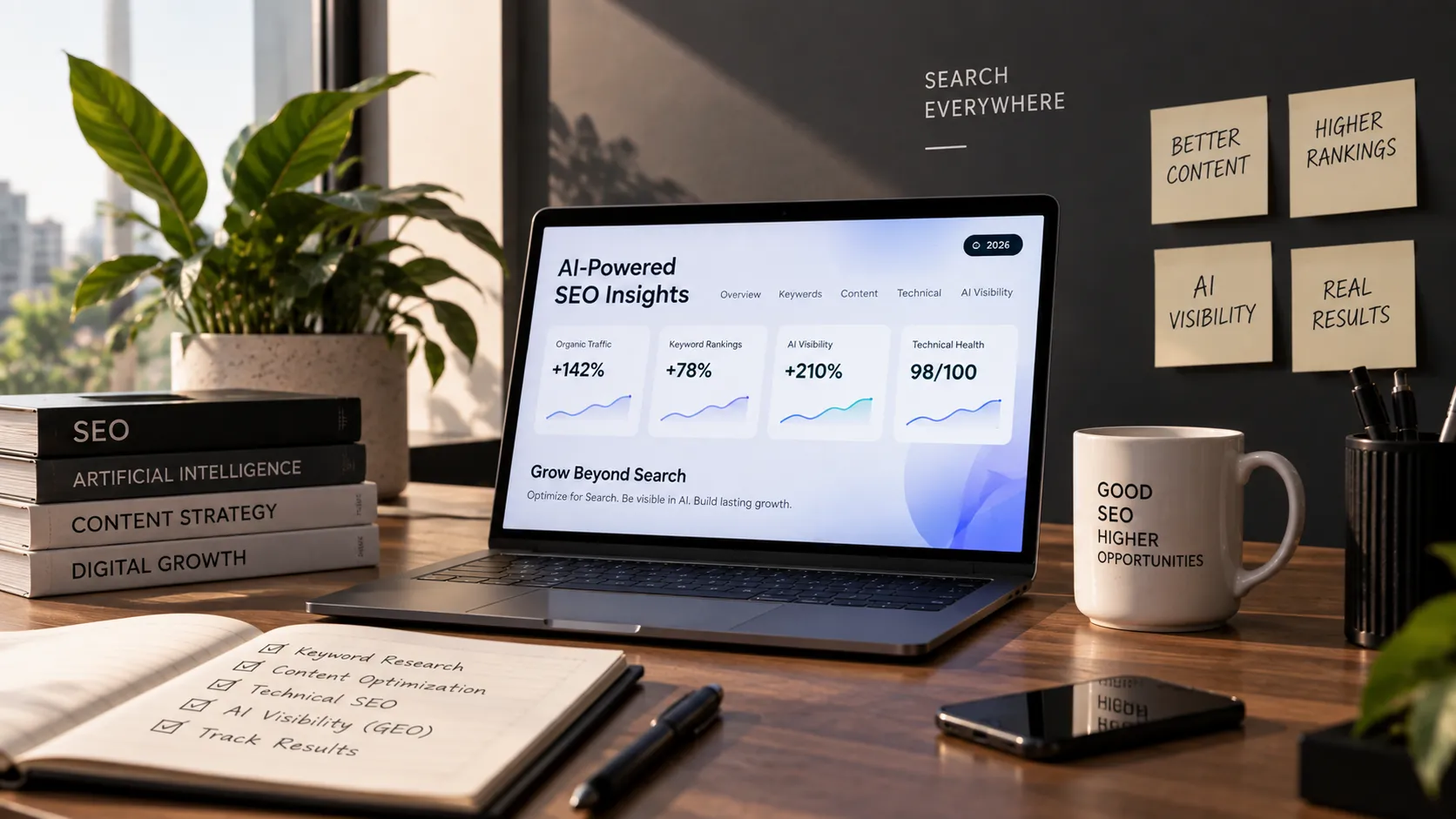
AI has changed SEO twice over. First it transformed the tools that do the work, and then it changed the destination, because ranking on Google is no longer enough when buyers ask ChatGPT and Google AI Overviews directly. The best AI SEO tools in 2026 help you do both: rank in traditional search and show up in AI answers, a discipline known as generative engine optimization, or GEO. This guide breaks down the tools that actually work, by category, and how to choose. For the strategy behind it, see our S-E-T framework for GEO.
Figures reflect widely reported 2025 to 2026 AI-search research.
The categories that matter
No single tool does everything well. The smart approach is a small stack, one strong tool per job. Here are the categories and the well-known options in each.
1. All-in-one SEO platforms
Tools like Semrush and Ahrefs remain the backbone: keyword research, competitor analysis, backlinks and rank tracking in one place. In 2026 both have added AI features for content and reporting. If you buy one platform, start here.
2. AI content optimization
Tools such as Surfer SEO, Clearscope and Frase help you write content that ranks, by analysing what already performs for a query and guiding structure and coverage. Used well, they raise quality; used lazily, they produce generic copy, so human judgement still matters.
3. Technical SEO
Screaming Frog and Sitebulb crawl your site to find the technical issues that hold rankings back. Increasingly they surface structured-data gaps too, which matters because schema markup is central to GEO.
4. AI visibility and GEO tracking
This is the newest and most important category. A growing set of tools now tracks whether ChatGPT, Gemini, Perplexity and Google AI Overviews mention and cite your brand. This is the AI-era equivalent of rank tracking, and it is how you measure the work in our AI reputation gap framework.
5. The AI assistants themselves
ChatGPT, Gemini and Perplexity are also research tools: use them to see how AI describes your brand and your competitors, to find content gaps, and to test whether your pages answer the questions buyers ask.
AI SEO tools by job
| Job | What to use | Why |
|---|---|---|
| Keyword and competitor research | Semrush, Ahrefs | Depth of data in one platform |
| Content optimization | Surfer, Clearscope, Frase | Guides coverage and structure |
| Technical SEO | Screaming Frog, Sitebulb | Finds crawl and schema issues |
| AI visibility / GEO | GEO tracking tools | Measures AI citations, the new metric |
| Research and testing | ChatGPT, Gemini, Perplexity | See how AI describes you |
How to choose the right tools
- Start with one all-in-one platform, not five overlapping ones.
- Add a content tool only if you publish regularly.
- Add an AI visibility tracker, because AI answers are where the next battle is.
- Remember tools inform, they do not replace strategy or judgement.
Mistakes to avoid with AI SEO tools
- Buying five overlapping tools. You pay for the same data twice and use none of it fully. Start with one strong platform.
- Publishing AI-optimized content without editing. Optimizers guide structure, but unedited output reads generic and can hurt trust. Human judgement is not optional.
- Ignoring AI visibility. If you only track Google rankings, you miss whether AI answers mention you at all, which is where a growing share of discovery now happens.
- Treating the tool as the strategy. Data is not direction. The tools speed up the work; they do not decide what to rank for or how to earn trust.
Tools are not a strategy
The biggest mistake in 2026 is treating AI SEO tools as a strategy in themselves. They surface data and speed up work, but they do not decide what to rank for, what story to tell, or how to earn the third-party coverage that AI engines trust. That still takes human strategy and real earned media. The best results come from a small, well-chosen tool stack in the hands of people who know how to use it.
Frequently Asked Questions
What are the best AI SEO tools in 2026?
The strongest stack usually combines an all-in-one platform (Semrush or Ahrefs), a content optimizer (Surfer, Clearscope or Frase), a technical crawler (Screaming Frog), and an AI visibility tracker for GEO. Match the tools to the jobs you actually do.
What is GEO, and do I need a tool for it?
GEO, or generative engine optimization, is the practice of making AI answer engines mention and cite your brand. As AI answers grow, tracking your AI visibility is becoming as important as tracking Google rankings, so a GEO tool is increasingly worth it.
Can AI tools replace an SEO team or agency?
No. Tools speed up research and content, but they do not set strategy, earn credible coverage, or exercise judgement about what to prioritise. The best results come from skilled people using a focused tool stack.
Do free AI tools work for SEO?
The AI assistants (ChatGPT, Gemini, Perplexity) are free and genuinely useful for research and testing how AI describes you. But for serious keyword, technical and visibility work, paid platforms give the depth you need.