How to Check Whether Your Existing Media Coverage Is Relevant to O-1A
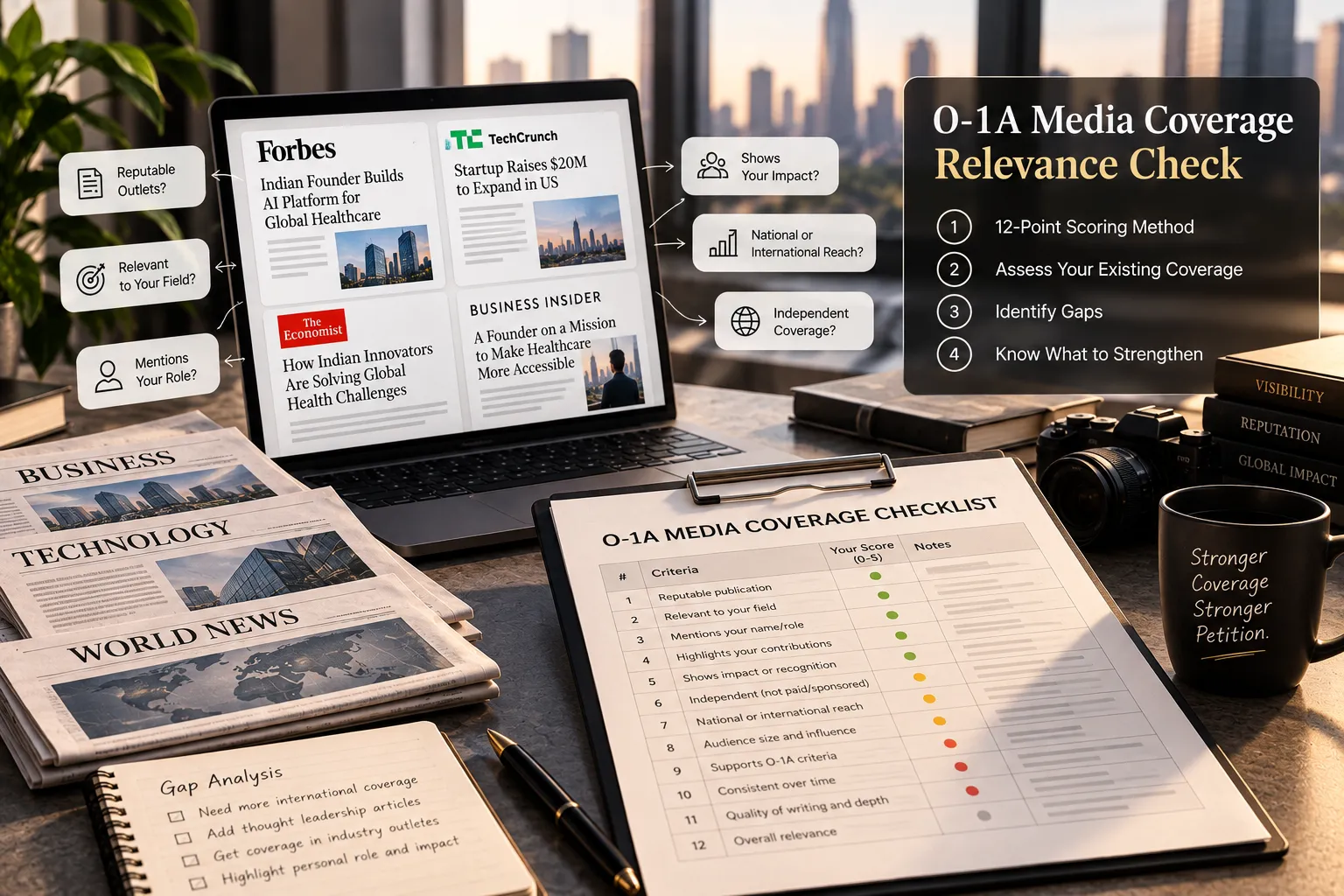
Many O-1A applicants already have some press. A podcast interview, a few trade articles, a funding story, a mention in a national paper. The question is whether any of it helps. Some of it may be strong evidence. Some may be irrelevant. A little may even work against you.
This guide gives you a simple way to check your existing coverage before you spend money on new PR. Think of it as an O-1A media coverage check. You will score each article, sort it into keep, review or set aside, and map what remains against the O-1 visa's eight criteria. It is a self-check, not an O-1 visa eligibility check, so share the results with your immigration attorney before you draw conclusions.
Before You Start: Gather Everything
Search your name, your company and your main projects in news search and on major platforms. Ask colleagues and your employer's communications team for anything they have saved. Collect:
- News and magazine articles, online and in print
- Trade publication features
- Podcast, radio and TV appearances
- Interviews and Q&As
- Award announcements and lists
- Articles you wrote yourself
Put every item in one spreadsheet with its link, outlet, date and author. You cannot judge relevance until you can see everything in one place.
The Six Questions to Ask About Every Article
These questions come from how USCIS describes the published material category in the USCIS Policy Manual and its guidance on how officers weigh that evidence.
- Is it about you? Does it discuss your work in a substantial way, or only mention your name or your employer?
- Is it about your field? Does it relate to the field in which you are claiming extraordinary ability?
- Is the outlet credible? Is it a professional publication, a major trade publication or major media, with an audience you can document?
- Is it independent? Was it written by a journalist and chosen by an editor, or was it paid for, sponsored or self-published?
- Is it complete? Does it show a title, date and author?
- Is it recent enough? Does it help show that your recognition is sustained, rather than a single moment years ago?
The Scoring Sheet
Score each question from 0 to 2. The maximum is 12 points per article. The scores are a sorting tool for you, not an official measure.
| Question | 0 points | 1 point | 2 points |
|---|---|---|---|
| About you | Name only, or not named | Quoted or discussed briefly | Substantial discussion of your work |
| Your field | Unrelated topic | Related field | Your exact field |
| Outlet credibility | Unknown site, no audience data | Smaller outlet with some data | Major media or respected trade title with documented reach |
| Independence | Paid, sponsored or self-published | Contributor or unclear | Staff or editorial journalism |
| Completeness | Missing author and date | Missing one of the two | Title, date and author present |
| Timing | Old with nothing since | A few years old | Recent, or part of steady coverage over time |
Sorting Your Results
Once every article is scored, sort them into three groups:
| Score | Group | What it usually means |
|---|---|---|
| 9 to 12 | Keep | Likely useful. Document fully and share with your attorney |
| 5 to 8 | Review | May help with context or another category. Ask your attorney |
| 0 to 4 | Set aside | Probably adds little. Keep a record, but do not rely on it |
One rule overrides the score. Any item scoring 0 on independence, such as a paid placement, should go to your attorney for a decision regardless of its total. Presenting paid content as editorial coverage can harm credibility.
Mapping Coverage to the O-1 Visa 8 Criteria
Coverage can support more than the published material category. For each "keep" or "review" item, note which of the O-1 visa 8 criteria it might help:
| Criterion | How coverage can help |
|---|---|
| Awards | Independent reporting on an award you received |
| Membership | Coverage of selective membership or fellowship |
| Published material | Articles about you and your work |
| Judging | Coverage of you serving on a jury or panel |
| Original contributions | Reporting on the impact of your work |
| Scholarly articles | Not supported by coverage; this is your own writing |
| Critical role | Profiles describing what you lead, plus coverage of your organization's reputation |
| High remuneration | Rarely supported by coverage |
Your attorney decides which criteria the petition will rely on. This map simply shows them where your media file is strong.
Finding the Gaps
After scoring and mapping, look for patterns:
- Too few "keep" items: you may need new, in-depth personal coverage.
- All coverage from one outlet: add independent outlets to show wider recognition.
- All coverage about the company: pitch stories about your own contribution.
- Nothing recent: add new coverage to show sustained recognition.
- Strong outlets, weak documentation: capture missing authors, dates and audience data now.
- Off-field coverage: refocus on trade publications in your field.
Each gap points to a specific next step, which is far more useful than simply "getting more press".
When to Get a Second Opinion
A self-check is a good start, but it has limits. You may score your own coverage generously, or miss signs of paid content. Before you invest in new PR, consider an outside review by someone who works with O-1A media evidence.
Public Media Solution offers a free review of your media footprint for O-1A applicants. It is a PR assessment to discuss with your attorney, not legal advice, and it does not predict the outcome of a petition.
A Worked Example
Here is how the scoring might look for four illustrative articles belonging to a fintech engineer. The outlets and figures are examples only. Q1 to Q6 follow the six questions above: about you, your field, outlet, independence, completeness and timing.
| Article | Q1 | Q2 | Q3 | Q4 | Q5 | Q6 | Total | Group |
|---|---|---|---|---|---|---|---|---|
| Profile in a national business daily | 2 | 2 | 2 | 2 | 2 | 2 | 12 | Keep |
| Funding story naming the engineer once | 0 | 2 | 2 | 2 | 2 | 2 | 10 | Review |
| Sponsored "innovator" feature | 1 | 2 | 1 | 0 | 1 | 2 | 7 | Ask counsel |
| Travel blog interview | 1 | 0 | 0 | 1 | 1 | 1 | 4 | Set aside |
Notice the second row. A high total can still hide a weak "about you" score. The funding story belongs in the review pile, because it may help show the company's reputation but says little about the engineer's own work. Always read the individual scores, not just the total.
What a Score Cannot Tell You
A simple scoring method is useful, but it has blind spots:
- It cannot judge legal strategy. Your attorney may value an article for a reason the score does not capture, or set aside one that scores well.
- It cannot confirm independence on its own. Some paid content carries no visible label. If you paid anything, record it.
- It does not compare outlets across countries. A leading outlet in your home country may deserve full marks for credibility once its reach is documented.
- It does not measure the whole case. Coverage is one part of an O-1A petition. Officers review the entire record.
Use the score to organize your thinking and start a better conversation with your attorney, not to reach a conclusion on your own.
Closing Thoughts
Your existing coverage is the foundation of your O-1A media file. Gather everything, ask the six questions, score each item, sort it, and map what remains against the eight criteria. You will see what is strong, what is missing and where to focus next, before you spend time or money on new coverage.
Key Takeaways
- Collect all existing coverage in one spreadsheet before judging any of it.
- Check each item for subject, field, outlet, independence, completeness and timing.
- Score items from 0 to 12 and sort them into keep, review and set aside.
- Flag any paid or sponsored content to your attorney.
- Map useful coverage to the O-1 criteria and act on the gaps.
FAQs
How do I know if my media coverage is relevant to O-1A?
Check whether it is about you and your work, in your field, in a credible and independent outlet, with a title, date and author, and recent enough to show sustained recognition.
Is this the same as an O-1 visa eligibility check?
No. It reviews only your media coverage. Eligibility depends on your full record, which your attorney assesses.
What if most of my coverage scores low?
That is common. Focus on earning a few substantial personal articles in credible outlets in your field.
Should I include old articles?
Yes, if they are strong. Combine them with recent coverage to show that your recognition is sustained.
Can I count articles I wrote myself?
Not as published material about you. They may support the authorship category if the outlet is credible.
Is a free media evaluation worth it?
An outside review can catch issues you miss, such as paid content or weak outlets. Treat it as input for your attorney, not a verdict. The same applies to an EB-1A profile evaluation or an EB-1A free evaluation offered by consultants.
This article is for general information only and is not legal advice. Media coverage does not guarantee O-1A approval. Please consult a qualified US immigration attorney about your situation.
Sources Used