Company News vs Personal Media Coverage for O-1A
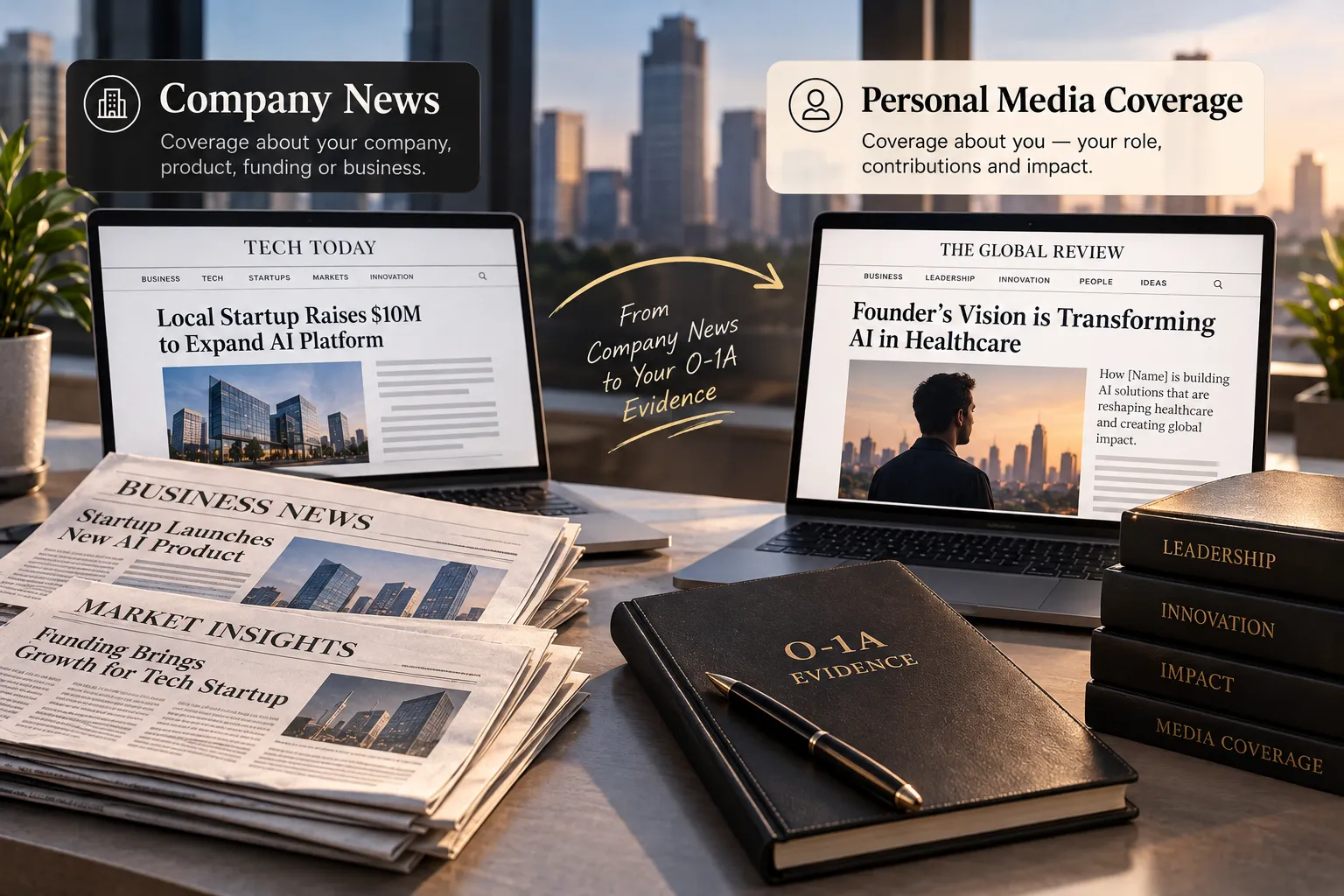
Founders and executives often have a folder full of press: funding rounds, product launches, partnership announcements. When they start preparing an O-1A petition, they discover that almost none of it is about them. The company is the hero of every story, and the founder appears as a name and a title.
This guide explains the difference between company news and personal media coverage for O-1A, how each can help, and how to turn company publicity into coverage that actually shows your role. It is written for startup founders, executives and senior engineers whose work is closely tied to their company's success.
Why the Difference Matters
The O-1A is a petition about a person, not a business. USCIS guidance says published material should be "about the person, relating to the person's work in the field, and not just about the person's employer and the employer's work", as set out in the USCIS Policy Manual.
That does not make company coverage useless. The same guidance allows broader material that "includes a substantial discussion of the person's work in the field and mentions the person in connection to the work". The test is whether the article explains what you did, not just what the company did.
What Company News Can and Cannot Do
Company news can:
- Show that the organization has a distinguished reputation, which supports the critical role category
- Confirm facts such as funding, customers or product launches that your attorney may cite elsewhere
- Support an original contributions claim when it credits your specific work
- Provide a starting point for personal stories
Company news usually cannot, on its own:
- Show that you personally are recognized in your field
- Meet the published material category when you are mentioned only in passing
- Explain your individual contribution when the article speaks only of "the team" or "the company"
What Personal Coverage Adds
Personal coverage puts you at the center. A founder profile, an executive interview or a feature about the engineer behind a breakthrough shows that a journalist found you, not just your company, worth writing about. That is the kind of independent recognition the published material category is designed to capture.
Personal coverage also travels with you. If you change roles or start a new company, a profile of your work remains evidence of your standing in the field.
Comparing the Two
How to Turn Company News Into Personal Coverage
You do not need to stop company PR. You need to change the angle. Here is a practical approach:
- Identify your contribution in each company milestone. What did you design, decide or lead? What would not have happened without you?
- Find the human story. Journalists respond to problems solved, risks taken and lessons learned. Your path to the milestone is often more interesting than the milestone.
- Offer access. Make yourself available for interviews when the company has news, and pitch the "person behind it" angle alongside the announcement.
- Use expert commentary. Comment on trends in your field. Regular commentary can lead to longer interviews about your own work.
- Ask for accuracy. When you are interviewed, give clear facts about your role so the article credits you correctly.
- Document the connection. Keep employer letters, patents and product records that confirm your role, so your attorney can link the coverage to your work.
Story Angles for Founders, Executives and Engineers
| Role | Company news angle | Personal coverage angle |
|---|---|---|
| Startup founder | "Startup raises Series A" | "Why this founder left a stable job to fix a problem in rural lending, and what it took" |
| Executive | "Company enters new market" | "The executive who rebuilt a struggling division into the company's fastest-growing unit" |
| Software engineer | "App releases new feature" | "The engineer behind the system that cut payment fraud for millions of users" |
| Researcher at a company | "Company publishes study" | "The scientist whose method made the study possible" |
The O-1 visa for startup founders and O-1 visa requirements, software engineer cases included, follow the same rules as any other O-1A petition. What changes is the story. Each personal angle names you, describes your contribution and links it to a result.
Using Both Types Together
The strongest O-1A media evidence usually combines both:
- Personal coverage to support the published material category
- Company coverage to support the distinguished reputation of the organization in your critical role claim
- Coverage of company results that credits you to support original contributions
Your attorney decides how each piece is used. A clear map of which articles are personal and which are corporate makes that decision faster.
If your coverage is mostly about your company, Public Media Solution offers founder-focused media coverage for O-1A designed to put your role on the record. It works alongside your attorney and does not guarantee approval.
Common Founder Scenarios
"All my coverage is about our funding round." Funding stories rarely discuss the founder's own work in depth. Keep them as evidence of the company's standing and pitch a follow-up profile on the problem you solved and how you built the product.
"My co-founder gets the interviews." Coverage that credits only your co-founder will not help your petition. Agree internally on who speaks about which part of the business, so your area of contribution gets its own spotlight.
"Our company was acquired." Acquisition coverage often names the founders. Look for articles that explain what you built and why it was valuable, and keep documents that confirm your role.
"I lead a team inside a large company." Corporate communications teams often speak for the company, not individuals. Ask whether you can be the named expert for your product area, or speak at conferences that attract trade press.
"My work is confidential." Some roles limit what you can say publicly. Focus on results you are allowed to share, industry commentary and conference talks. Your attorney can use other evidence, such as employer letters, to describe confidential work.
How to Brief Your Communications Team
If your company has a PR or communications team, they can help, but their goal is usually the company's brand. A short briefing can align both goals:
- Explain that you would like to be named and quoted on work you led.
- Share a list of milestones where your contribution was central.
- Ask to be offered as a spokesperson for stories in your area of expertise.
- Request copies of all coverage that mentions you, with dates and authors.
- Make sure any statements about your role are accurate and documented.
Most teams are happy to help, especially when personal coverage also raises the company's profile.
Closing Thoughts
Company news shows that your company matters. Personal coverage shows that you matter. An O-1A petition needs the second, and it benefits from the first. Review your existing press, identify your contribution in each milestone and pitch the person behind the news. The coverage you earn will serve both your petition and your career.
Key Takeaways
- USCIS wants coverage about you, not only about your employer.
- Company news can support the distinguished reputation of your organization.
- Personal profiles and interviews are the strongest evidence for published material.
- Turn company milestones into stories about your contribution.
- Keep documents that link you to the work described in each article.
FAQs
Does company news count for O-1A?
It can support other categories, such as showing that your organization is distinguished. For published material, it needs a substantial discussion of your own work.
Is a founder profile stronger than a company article?
Usually, yes. A profile is about you and your work, which is what the published material category looks for.
What if the article credits "the team" rather than me?
Team coverage may help if it names you in connection with the work or other evidence documents your significant role. Keep employer letters that explain your part.
Can a funding announcement help an O-1A petition?
It can show the company's standing and support other evidence, but it rarely works as published material about you on its own.
How can an engineer get personal coverage?
Pitch stories about the problem you solved and its impact, offer expert commentary and speak at recognized conferences that attract press.
Is there a separate O-1 visa startup founder category?
No. Founders apply under the same O-1A rules. What matters is evidence of your own extraordinary ability, including coverage about your role.
Should I stop company PR while preparing my petition?
No. Keep it, but add a personal angle to each milestone and make yourself available for interviews.
This article is for general information only and is not legal advice. Media coverage does not guarantee O-1A approval. Please consult a qualified US immigration attorney about your situation.
Sources Used