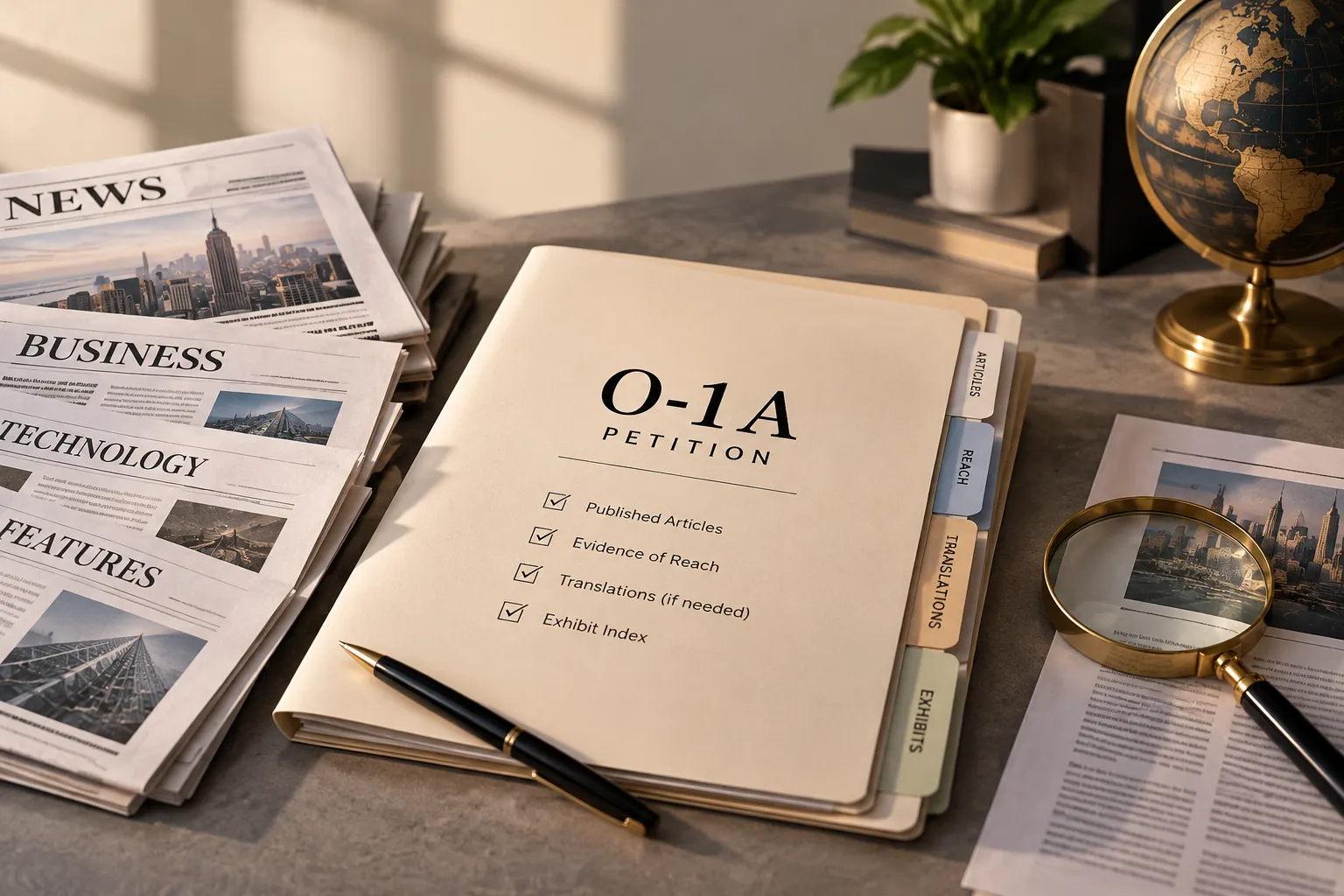
How to Document Media Coverage for an O-1A Petition
Earning good press is only half the job. The other half is turning each article into evidence an immigration officer can check in minutes. Many applicants hand their attorney a list of links and assume the work is done. Months later, a link breaks, a paywall blocks the article or an officer asks how large the outlet's audience is, and no one has the answer.
The cost of that gap is real. Nearly 1 in 5 O-1 petitions received a request for evidence in fiscal year 2025. A clean, complete media file is one of the easiest ways to avoid giving an officer a reason to ask for more. This guide shows how to document media coverage for O-1A step by step, from capture to the final exhibit index your attorney can work with.
Why Documentation Matters as Much as the Coverage
An officer reviewing an O-1 visa petition does not search the web for you. They read what is in the file. If an article is missing its author, its date or proof of the outlet's audience, the officer has to guess, and guesses rarely go the applicant's way.
Good documentation also protects you over time. Websites redesign, articles move behind paywalls and some outlets close. The version you saved on publication day may be the only reliable copy left when your attorney assembles the O-1 visa application.
What USCIS Expects Each Article to Show
The USCIS Policy Manual describes the O-1A published material category as material in professional or major trade publications or major media about the beneficiary and their work. It states that the evidence must include the title, date and author of the material, plus any necessary translation.
USCIS guidance on how officers weigh published material adds that they consider the intended audience and the "relative circulation, readership, or viewership" of the outlet. So every article needs two things in the file: the article itself and proof of the outlet behind it.
Step 1: Capture Each Article the Day It Is Published
Save several versions, because each one does a different job:
- A full-page PDF of the article, including the masthead, headline, byline and date
- A dated screenshot showing the URL bar
- An archived copy on a public web archive such as the Internet Archive's Wayback Machine, which gives a third-party timestamp
- The print edition, if one exists, as a scan of the full page with the publication name and date visible
If the article is behind a paywall, save it while you have access. An officer will not log in to read it.
Step 2: Record the Core Details
For each article, record the following in one place:
- Title and subtitle
- Publication name
- Author's name and role, such as staff reporter or editor
- Publication date, plus the date you captured it
- Live URL and archive URL
- Section of the outlet, such as news, features or technology
- Word count and how much of the article discusses you
The last point matters. An officer wants to see a substantial discussion of your work. Highlight the relevant paragraphs in a copy of the PDF so your attorney can point to them quickly.
Step 3: Prove the Outlet's Reach and Standing
An article with no proof of the outlet's reach is half an exhibit. Build a short profile for each publication:
Save this proof at the same time as the article, because traffic and circulation figures change. Independent sources are stronger than an outlet's own claims, so combine both where you can.
Step 4: Translate Foreign-Language Coverage Properly
Coverage in your home country can count. Under USCIS filing rules, any document in a foreign language must come with a full English translation and a certification from the translator that the translation is complete and accurate and that they are competent to translate.
Three practical tips:
- Translate the whole article, not only the paragraphs about you.
- Translate the headline, captions and byline too.
- Keep the original and the translation together as one exhibit.
Step 5: Handle Video, Audio and Podcast Coverage
USCIS lists "a transcript of professional or major audio or video coverage" among acceptable forms of published material. For each broadcast or podcast appearance, save:
- A written transcript of the full segment
- The show name, episode title, air date and host
- A link to the recording and a downloaded copy
- Audience data, such as viewership, rankings or download figures
If the segment is not in English, the transcript needs a certified translation as well.
Step 6: Build an Exhibit Index for Your Attorney
Once you have several articles, organize them so your attorney can use them without reformatting:
- Number each article in date order.
- Create a one-page summary for each: title, outlet, date, author, a two-line description and the key paragraph about you.
- Attach the outlet profile directly behind each article.
- Group coverage by theme, such as product launch, research results or awards, so your attorney can see which achievements are best supported.
- Keep a master spreadsheet with every detail from Step 2 and the status of each item.
Your attorney decides how exhibits are labeled and presented in the petition. Your job is to give them a complete, verified set.
A Sample Media Evidence Record
Here is what a single record might look like in your master file. All details below are illustrative.
| Field | Example |
|---|---|
| Exhibit no. | M-03 |
| Title | "The Engineer Teaching Banks to Spot Fraud in Real Time" |
| Outlet | A national business newspaper |
| Author | Named staff technology reporter |
| Date published | 12 March 2026 |
| Captured on | 12 March 2026 (PDF, screenshot, web archive) |
| Discussion of applicant | Six of nine paragraphs; two direct quotes |
| Outlet reach | Media kit readership figures and traffic estimate saved |
| Translation | Not needed |
| Notes | Editorial interview arranged after a conference talk |
How Good Documentation Helps With an O-1 Visa Request for Evidence
When an officer issues an O-1 visa request for evidence about published material, the questions are usually predictable. Is the article about you? Is the outlet major media or a recognized trade publication? Who wrote it, and when? A well-built media file answers each one in advance.
If a request does arrive, your attorney can respond quickly, because the outlet data, translations and highlighted paragraphs already exist. That saves weeks, and in a premium processing case it can keep the timeline on track.
For applicants who want help preparing this kind of file alongside their legal team, Public Media Solution offers O-1A media evidence documentation support. It is PR support for attorney review, not legal advice.
Common Documentation Gaps Attorneys See
Even well-organized applicants tend to miss the same few things:
- Missing bylines. The article was saved from a mobile view or a social share that hid the author's name.
- Cropped dates. Screenshots that cut off the publication date at the top or bottom of the page.
- Dead links. Articles moved during a site redesign, with no archived copy.
- Paywalled copies. Saved pages that show only the first paragraph.
- Undocumented outlets. Strong articles in smaller trade titles with no proof of who reads them.
- Partial translations. Only the paragraphs about the applicant were translated.
- Duplicates. The same story syndicated on several sites, listed as separate articles.
Each gap is easy to fix on the day of publication and hard to fix months later. Build the habit early.
Setting Up a Simple Media Evidence System
You do not need special software. A shared cloud folder and one spreadsheet are enough.
Folder structure: one folder per article, named with the date and outlet, for example "2026-03-12 National Business Daily". Inside it, keep the PDF, the screenshot, the archive link, the outlet profile and any translation.
Spreadsheet columns: exhibit number, title, outlet, author, date published, date captured, live URL, archive URL, section, paragraphs about you, outlet reach evidence, translation status and notes.
Review rhythm: check the spreadsheet once a month. Confirm that links still work, that every article has a complete record and that your attorney has the latest version.
This system also helps after the petition. Extensions and future green card filings often draw on the same coverage, and a tidy archive saves you from rebuilding it.
Closing Thoughts
Strong coverage can lose much of its value if it is poorly documented. Capture every article on the day it runs, record the core details, prove the outlet's reach, translate properly and hand your attorney an organized index. These steps take a few hours per article and can save weeks of stress later.
Key Takeaways
- Every article needs its title, date and author, plus proof of the outlet's audience.
- Save a PDF, a dated screenshot and an archived copy on publication day.
- Foreign-language coverage needs a full certified English translation.
- Podcasts and broadcasts need full transcripts with show details.
- An organized exhibit index makes your attorney's work faster and a request for evidence easier to answer.
FAQs
How do I document media coverage for O-1A?
Save each article as a PDF, a screenshot and an archived copy, record the title, date, author and URL, add proof of the outlet's audience and organize everything in an exhibit index for your attorney.
Is a link to the article enough?
No. Links break and paywalls block access. Officers need a complete saved copy of the article in the file.
How do I prove an outlet is major media?
Use circulation or readership figures, traffic estimates, audited data where it exists and evidence of the outlet's standing, such as rankings or industry awards.
Do I need to translate the whole article?
Yes. USCIS requires a full English translation with a translator's certification, not a summary of the parts about you.
What if the article has no author?
Save it, but treat it as weaker evidence. The published material rule asks for the author, so an unsigned article may raise questions. Discuss it with your attorney.
Should I document articles that only mention me briefly?
Keep a record, but flag them as background. Brief mentions rarely meet the standard of material about you.
Can I reuse this documentation for an EB-1A petition?
Often, yes. EB-1A media coverage is assessed under very similar published material rules, so a well-kept file gives your attorney a head start if you later pursue a green card.
Who prepares the final exhibits?
Your immigration attorney decides how exhibits are labeled and presented. You or your PR team can prepare a complete, organized set of source material.
This article is for general information only and is not legal advice. Media coverage does not guarantee O-1A approval. Please consult a qualified US immigration attorney about your situation.
Sources Used