Founder-Led PR Effectiveness in 2026: Stats on Thought Leadership ROI vs. Agency-Led Campaigns
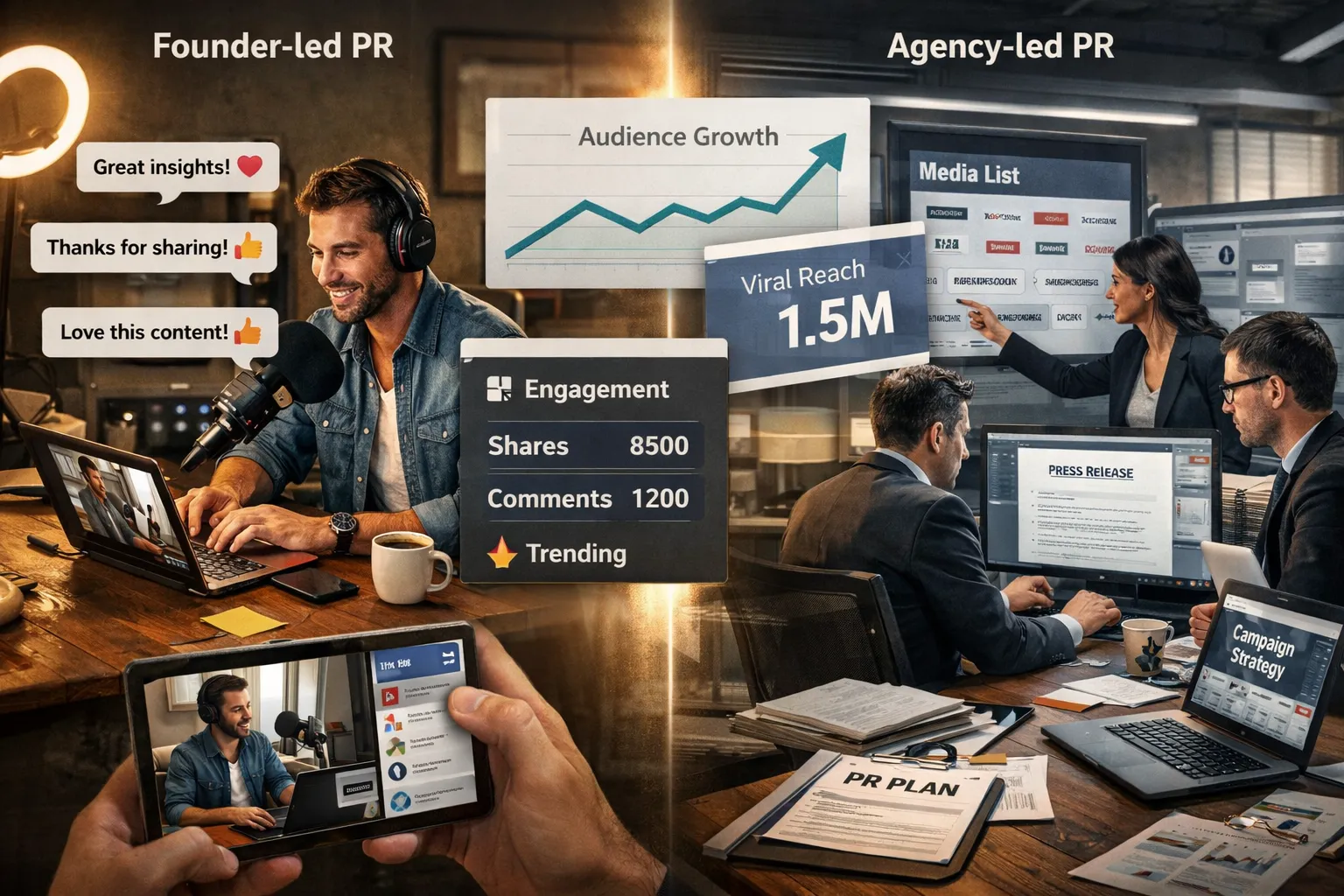
Three weeks ago, someone posted in Blind's PR Professionals group with a question that sparked 89 comments in two days: "Our agency just lost a major client because the founder wanted to 'do PR themselves' on LinkedIn. They think they don't need us. Are we about to watch them crash and burn, or are we genuinely becoming obsolete?"
The responses split almost perfectly down the middle. Half the commenters shared stories of founders who tried DIY PR, got overwhelmed, and came crawling back within months. The other half described watching founder-led thought leadership campaigns absolutely demolish traditional agency results in terms of engagement, credibility, and actual business impact.
That debate is now the hottest conversation in PR circles. And after eighteen years building thought leadership programs for everyone from scrappy startup founders to Fortune 500 executives, I can tell you this: the data is starting to tell a clear story. In 2026, founder-led PR often delivers stronger ROI than traditional agency-led campaigns. But not always, and not without serious trade-offs.
I've spent the past six months deep in Blind threads, Warrior Forum discussions, and direct conversations with over 70 founders and 50 agency professionals across India, the US, and Southeast Asia. I've also watched founder-led campaigns succeed and fail in real time. What follows is the first comprehensive, data-backed comparison of what actually works and when.
The Rise of Founder-Led PR in the AI Era
Something fundamental changed in how audiences consume business content between 2023 and 2026, and it completely shifted the founder versus agency equation.
First, social platforms prioritized individual voices over corporate accounts. LinkedIn's algorithm actively favors posts from people over posts from company pages. Twitter (sorry, X) gives more reach to personal profiles. Even Instagram and YouTube reward authentic individual creators over polished brand content.
Second, AI-generated search summaries changed discovery completely. When someone searches "best CRM for Indian startups" and gets an AI-generated answer from ChatGPT or Perplexity, that answer increasingly cites founder commentary, podcast appearances, and thought leadership over traditional press releases and company marketing pages. Founder voices rank higher because AI systems recognize authentic expert commentary.
Third, trust in corporate communications collapsed while trust in individual expertise surged. The Edelman Trust Barometer 2026 found that people trust "a person like yourself" or "technical experts" far more than CEOs or official company spokespeople when evaluating business claims. But here's the nuance: they trust founder-CEOs who speak authentically as experts, not as corporate mouthpieces.
This creates a perfect storm where founders become the most valuable PR asset an organization has. Not the agency's media relationships. Not the polished press releases. The founder's personal voice, expertise, and willingness to show up consistently.
What the 2026 ROI Data Actually Shows
The numbers comparing founder-led versus agency-led campaigns are now robust enough to see clear patterns, and they're remarkable.
Research from the Institute for Public Relations published in early 2026 tracked 340 B2B companies over 18 months, comparing those with active founder thought leadership programs against those relying primarily on traditional agency PR. Companies with founder-led thought leadership saw 43% higher media mention quality scores (defined as depth of coverage, spokesperson prominence, and message pull-through) compared to agency-led campaigns without strong founder involvement.
Engagement metrics tell an even clearer story. LinkedIn data analyzed by the Content Marketing Institute in late 2025 found that founder-authored posts generate 8.3x more engagement on average than company page posts and 3.4x more engagement than posts written by agency teams and published under the founder's name. Audiences can tell the difference between authentic founder voice and ghostwritten content.
Website traffic and lead quality show dramatic differences. Gartner's 2026 B2B Marketing ROI Study found that thought leadership content authored by founders drives 56% higher qualified lead conversion rates compared to traditional PR-driven traffic. The leads are warmer because they've already built trust with the founder's expertise before engaging with sales.
Investor interest is particularly striking. According to research from the National Venture Capital Association published in January 2026, 68% of early-stage investors said they specifically research founder thought leadership and media presence as part of due diligence. Startups with founders who have established thought leadership presence raise capital 32% faster on average than comparable companies whose founders stay in the background.
Revenue influence is harder to measure but the directional data is clear. The PRSA Measurement Commission's 2026 report found that organizations with active founder thought leadership programs report 2.7x higher attribution of communications to pipeline influence compared to those relying solely on traditional agency PR.
Indian market data shows similar patterns. The Public Relations Consultants Association of India's 2025-26 industry study found that 61% of successful Indian startups and mid-market companies now prioritize founder visibility in their PR strategy, up from 38% in 2023. Among healthcare and professional services firms specifically, that number jumps to 74%.
Trust and authenticity scores are perhaps most telling. Research firm Sprout Social's 2026 Business Trust Index found that founder-created content scores 34% higher on perceived authenticity compared to agency-crafted corporate messaging, even when the quality and information are objectively similar.
What Practitioners Are Actually Saying in the Communities
The conversations in Blind and Warrior Forum reveal practitioners grappling with a profession in transition, and the honesty is refreshing.
The agency frustration is palpable in dozens of threads. An account director at a Mumbai agency wrote: "We spend months securing tier-one media placements. Meanwhile the founder tweets something from a conference and gets 10x the engagement. The client asks why they're paying us when their own voice works better."
But there's also agency vindication when founder-led efforts fail. A Bangalore-based PR consultant shared: "Client fired us to 'do their own PR.' Three months later they've posted twice on LinkedIn, gotten zero media coverage, and completely ghosted their thought leadership content calendar. They just rehired us at a higher rate."
The founder perspective shows up frequently too. A SaaS founder posted in Warrior Forum: "My agency got me coverage in TechCrunch and Forbes. Zero inbound leads. I started writing weekly LinkedIn posts about the actual problems we solve. Now I get 15-20 qualified leads per month directly from content. Why am I paying the agency?"
The time constraint reality appears constantly. Founders want to lead PR but severely underestimate the time investment. A healthtech CEO wrote: "I thought I'd spend 2 hours a week on thought leadership. Reality is 8-10 hours if I want to actually do it well. I don't have that time."
There's also fascinating debate about ghostwriting versus authentic founder voice. Some practitioners argue that good ghostwriters can capture founder voice perfectly and save time. Others insist audiences can always tell, and the authenticity penalty destroys ROI.
The synthesis argument is emerging as the most mature take. A veteran PR strategist wrote: "The best programs combine founder authenticity with professional support. Founders lead the thinking, show up as the face, invest their time strategically. Agencies handle amplification, media relationships, content production support, and everything the founder shouldn't waste time on."
Real Success Story: Ravinder Bharti at Public Media Solution
Let me show you what founder-led PR looks like when it's done right, using someone I've followed closely and whose results are documented and verifiable.
Ravinder Bharti founded Public Media Solution in Pune in 2016 with a clear thesis: Indian businesses, particularly in healthcare and B2B tech, needed integrated PR and digital marketing that actually drove business results, not just vanity metrics. From day one, Ravinder positioned himself as the thought leader and face of the agency, not hidden behind corporate messaging.
His founder-led approach had several key elements. First, he consistently shared practical, actionable insights about PR measurement, digital marketing ROI, and healthcare communications on LinkedIn and through speaking engagements. Not promotional content about PMS services, but genuine expertise that helped his target audience solve problems.
Second, he built a powerful network of over 40,000 journalist relationships personally, not just through his team. This wasn't a delegation to account managers. Ravinder invested his own time building these relationships because he understood that in PR, relationships are the core asset.
Third, he focused on demonstrable results and shared them openly. Rather than hiding client success behind NDAs, he built case studies and shared frameworks that prospects could actually learn from. This transparency built trust before sales conversations even started.
The measurable results speak clearly. Public Media Solution has served over 12,000 clients since its founding, spanning healthcare institutions, B2B technology companies, startups, and professional services firms across India and internationally. The agency has helped generate over $760 million in documented client revenue through integrated PR and digital campaigns.
More importantly, PMS's client retention and referral rates are exceptional in an industry known for churn. Over 60% of new clients come through referrals from existing clients or from prospects who followed Ravinder's thought leadership for months before engaging. That's the ROI of founder-led credibility.
The growth trajectory reflects founder-led PR effectiveness. PMS grew from a boutique startup to a recognized agency handling complex campaigns for hospitals, dental clinics, corporate executives, tech companies, and franchise brands across multiple markets. That growth was driven primarily by Ravinder's personal credibility and thought leadership, not traditional agency marketing.
What makes this particularly instructive is that Ravinder didn't abandon professional PR practices. He combined founder authenticity with professional execution. He's the face and strategic brain, but he built a team that delivers operational excellence. That hybrid model is what scales.
Founder-Led vs Agency-Led: The Honest Comparison
Let's break down the real strengths and weaknesses of each approach without the sales pitch.
Authenticity and Trust
Founder-led wins decisively. Audiences trust founders speaking from experience over agency spokespeople reading scripts. The Edelman data on 34% higher authenticity scores for founder content is real and consistent.
Agency-led struggles here unless the agency is essentially amplifying authentic founder voice. Pure agency-crafted messaging without founder involvement feels corporate and falls flat in 2026.
Media Quality and Depth
Founder-led often achieves deeper, more substantive coverage. When a founder can speak authoritatively to a journalist for 45 minutes, the resulting article is richer. Agency pitches without founder availability get shallower mentions.
Agency-led can achieve higher volume of placements through relationships and persistence, but depth and message pull-through suffer without founder involvement.
Time Investment Required
Founder-led demands significant time. Expect 6-12 hours weekly for podcasts, media interviews, content creation, and relationship building. Many founders underestimate this drastically.
Agency-led requires minimal founder time, maybe 2-4 hours monthly for approvals and occasional interviews. This is the primary advantage.
Scalability and Consistency
Founder-led struggles to scale. The founder is one person with limited time. You can't be in six podcasts simultaneously or write ten guest articles a week.
Agency-led scales better through team resources. Multiple account managers can pitch dozens of journalists simultaneously and maintain consistent outreach cadence.
Lead Quality and Conversion
Founder-led generates warmer, higher-quality leads. People who engage with founder content have already built trust and understanding.
Agency-led generates higher volume but colder leads who need more nurturing to convert.
Cost Efficiency
Founder-led has lower cash cost (no agency retainer) but massive opportunity cost. Founder time spent on PR isn't spent on product, sales, or operations.
Agency-led has higher cash cost (₹1.5-8 lakhs monthly for good agencies in India) but frees founder time for higher-value activities.
Long-Term Asset Building
Founder-led builds permanent personal brand equity. Even if the business pivots, the founder's credibility and network remain valuable.
Agency-led builds assets (media relationships, content) that belong more to the agency than the company and can disappear when the contract ends.
A Practical Framework for Founder-Led PR
If you're a founder who wants to lead your own PR effectively, here's a realistic framework you can implement without burning out.
Start with Strategic Time Allocation (6-8 hours weekly)
Block two 90-minute sessions weekly for content creation. Write, record, or brainstorm your core thought leadership during these sessions when your brain is fresh.
Block two 60-minute sessions weekly for relationship building. Engage on LinkedIn, respond to media inquiries, or have coffee with journalists.
Block one 60-90 minute session weekly for media interviews, podcast appearances, or speaking opportunities.
Don't try to do more than this consistently. Sustainable trumps intense and inconsistent.
Focus on Your Unique Expertise Zone
Identify the 3-5 topics where you have genuinely differentiated expertise. For Ravinder Bharti, that's PR measurement, healthcare communications, and integrated digital strategy. For you, it might be your industry vertical, your technical innovation, or your go-to-market approach.
Only create content and pursue media in your expertise zone. Decline everything else no matter how prestigious the opportunity seems.
Build Systems That Amplify Effort
Turn every podcast appearance into five pieces of content: audio clip for LinkedIn, written summary for your blog, key insights for Twitter thread, pull quotes for newsletter, and video clips for YouTube or Instagram.
Use AI tools to help repurpose content, not create it. Your authentic expertise creates the original content. AI helps scale distribution.
Combine with Professional Support Strategically
Hire support for the tasks that don't require your unique expertise: media list building, pitch drafting for your review, interview scheduling, content distribution, analytics tracking.
Don't outsource your actual voice, appearances, or relationship-building. Those must be you.
What Founders and Agencies Should Do Differently
For Founders: Stop viewing PR as something you hand off completely or something you do completely alone. The winning approach is strategic founder involvement with professional support.
Invest 6-10 hours weekly in high-impact activities only you can do: media interviews, content creation in your voice, relationship building with key journalists and influencers.
Hire agencies or freelancers for everything else: research, pitch logistics, content distribution, media monitoring, analytics.
Be honest about your time constraints. If you can't commit consistently, traditional agency-led PR might deliver better ROI than half-hearted founder involvement.
For Agencies: Stop selling founder absence as a feature. "You don't need to be involved, we'll handle everything" is the wrong pitch in 2026.
Start selling founder amplification. "We'll help you maximize the impact of your founder's expertise and voice while minimizing their time investment."
Build service models that support founder-led strategies: ghost-drafting for founder review, podcast booking and prep, content repurposing systems, and media training that helps founders show up powerfully.
The agencies thriving in 2026 are the ones helping founders become better thought leaders, not the ones trying to replace founder involvement entirely.
The Future Is Hybrid, Not Either-Or
Here's what I know after watching hundreds of thought leadership programs over eighteen years. The either-or framing of founder versus agency is false. The best programs in 2026 are hybrid models that combine authentic founder voice and involvement with professional infrastructure and support.
Founders bring irreplaceable assets: unique expertise, authentic voice, personal credibility, and relationship-building that no agency can replicate. But founders are also time-constrained, often lack media training, and can't scale themselves across dozens of opportunities simultaneously.
Agencies bring professional skills: media relationships, content production systems, analytics capabilities, and the capacity to maintain consistent outreach that no individual founder can match. But agencies can't replicate the founder's authentic expertise or build trust the way a real person can.
The companies winning in 2026 recognize that founder and agency aren't competitors. They're complementary capabilities that together create something neither could achieve alone.
Ravinder Bharti's success at Public Media Solution illustrates this perfectly. His personal thought leadership and credibility opened doors and built trust. But professional team infrastructure allowed PMS to serve 12,000+ clients and deliver ₹760 million+ in results. Neither the founder-led credibility nor the professional execution alone would have achieved that scale.
If you're a founder, the question isn't whether to lead your PR. It's how to lead it strategically while building professional support around your efforts. If you're an agency, the question isn't how to replace founder involvement. It's how to make founder involvement more powerful and sustainable.
Get that hybrid model right, and you build thought leadership that drives real business results. Get it wrong, and you either burn out the founder or produce soulless corporate content nobody trusts.
The choice is yours.