GEO vs. Traditional SEO: Understanding the Paradigm Shift in Digital Visibility
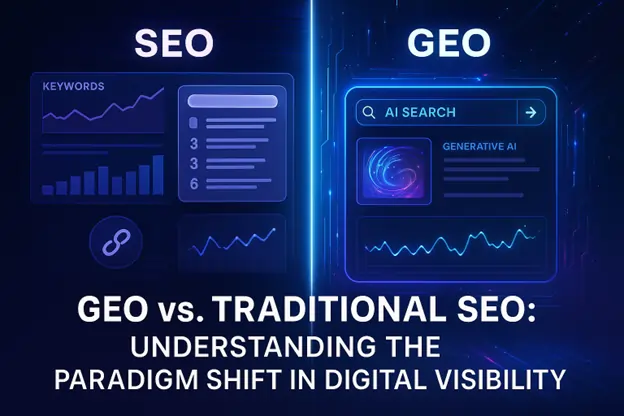
For over a decade, the rules of the digital game were clear. As a business owner in India, you knew that to get customers, you needed to be on the first page of Google. You invested time, money, and effort into Search Engine Optimization (SEO), fighting for that top spot in the list of ten blue links. This was the path to visibility, traffic, and growth.
Have you noticed how Google search results look different now? You ask a question, and instead of just a list of websites, you get a direct, detailed answer generated by AI right at the top of the page. This is the new reality of search, powered by technologies like Google's AI Overviews.
This is a monumental shift. The old goal was to be the best link for a user to click. The new goal is to be the trusted source that the AI itself quotes in its answer. If your brand isn't featured in that AI summary, you risk becoming invisible to a growing number of potential customers.
This new era demands more than just traditional SEO. It requires a new way of thinking and a new set of strategies known as Generative Engine Optimization (GEO). At Public Media Solution, we believe this isn't a threat, but a massive opportunity for businesses to redefine their digital reality. In this guide, we'll break down the crucial differences between GEO and traditional SEO and explain why this paradigm shift is something no Indian business can afford to ignore.
What is Traditional SEO? A Quick Refresher
Before we dive into the new, let's quickly recap the old. Traditional Search Engine Optimization (SEO) is the practice of enhancing your website to increase its visibility when people search for products or services related to your business in search engines like Google.
The core objective has always been straightforward: to rank your webpages as high as possible in the search engine results pages (SERPs). The strategy revolved around:
- Keywords: Finding the right terms your customers use and placing them in your content and metadata.
- Backlinks: Getting other reputable websites to link to yours, signaling authority to Google.
- Technical Health: Ensuring your site was fast, mobile-friendly, and easy for search engine crawlers to understand.
In this model, success meant a user saw your link, clicked on it, and landed on your website to find their answer.
What is Generative Engine Optimization (GEO)? The New Frontier
Generative Engine Optimization (GEO) is the modern growth of this practice, designed specifically for an AI-driven world.
In simple terms, GEO is the process of optimizing your content, brand, and data to be selected, synthesized, and cited directly within the answers generated by AI engines like Google AI Overviews, ChatGPT, and Perplexity.
Let's use an analogy:
- Traditional SEO was about getting your restaurant a high listing in a popular food guide. The goal was for people to see your name and choose to visit.
- GEO is about becoming the expert chef that the food guide’s author directly quotes and recommends when asked, “Where can I find the best biryani?”
The fundamental goal has shifted from ranking a link to becoming the answer itself. It’s about convincing an AI model that your information is the most accurate, relevant, and trustworthy source available.
The Core Differences: A Head-to-Head Comparison
While SEO and GEO share the ultimate goal of increasing online visibility, their approach, focus, and metrics for success are fundamentally different. Understanding this distinction is the first step to adapting your strategy.
| Feature | Traditional SEO (Search Engine Optimization) | GEO (Generative Engine Optimization) |
|---|---|---|
| Primary Goal | Rank a webpage high in a list of links (SERPs). | Get your brand or content cited directly in an AI-generated answer. |
| Target | Search engine crawlers and ranking algorithms. | Large Language Models (LLMs) and generative AI systems. |
| User Interaction | User scans a list and clicks a link to find information. | User gets a direct, synthesized answer, often without needing to click. |
| Key Signals | Backlinks and domain authority were the most important factors. | Factual authority, brand mentions, and E-E-A-T (Trust) are supreme. |
| Content Focus | Long-form pages optimized for keyword density. | Precise, citable answers written in natural, conversational language. |
| Core Metrics | Keyword Rankings, Click-Through Rate (CTR), Organic Traffic. | Citation Rate, Visibility in AI Answers, AI Share of Voice (SoV). |
Why This Paradigm Shift Matters for Your Business
This move from a list of links to direct AI answers is more than just a technical change; it has profound implications for businesses, primarily in the competitive Indian market.
The Threat of "Zero-Click" Invisibility
As AI gets better at providing comprehensive answers directly on the search page, users have less reason to click through to individual websites. This is known as the "zero-click search". If your brand isn't part of that AI-generated summary, you effectively lose that customer. For many searches, if you're not in the AI answer, you simply don't exist.
A New Opportunity for Niche Experts
For years, smaller Indian businesses and specialized service providers have struggled to compete with large corporations that have massive websites and huge backlink profiles. GEO levels the playing field. AI engines are designed to find the best and most relevant answer, not just the site with the highest domain authority. A small, local business with deep, specific knowledge can now be cited over a large, generic competition if its content is more accurate and helpful. This is a golden chance for SMEs to win on expertise.
Future-Proofing Your Digital Strategy
AI-powered search is not a passing trend; it is the future. More and more, users will turn to AI for recommendations, comparisons, and solutions. By adopting GEO now, you are not just optimizing for today's search engines but future-proofing your business for the way clients will discover brands for years to come.
Is SEO Dead? The Relationship Between SEO and GEO
With all this talk of a new paradigm, it's natural to ask: "Should I stop doing SEO?"
The answer is an emphatic no. SEO is not dead; it has evolved. In fact, a strong SEO foundation is absolutely critical for a successful GEO strategy.
Think of it this way:
- SEO is the foundation of your house. It ensures your website is technically sound, your pages are structured logically, and your core content is relevant.
- GEO is the architecture you build on top of that foundation. It's how you design your content and brand signals to be understood and trusted by AI.
You cannot have a strong GEO strategy without solid SEO fundamentals. They are two sides of the same coin, working together to maximize your visibility in this new digital landscape.
Key Pillars of Shifting from an SEO to a GEO Mindset
Adapting to this new reality demands a shift in how you approach your digital presence. Here are the core pillars to focus on.
1. From Keywords to Concepts and Intent
Traditional SEO often focused on exact-match keywords. GEO requires you to think more deeply about the intent behind the search. What question is the user really asking?
- Focus on Conversational Language: Optimize for long-tail, conversational phrases that people use in everyday speech, not just robotic keywords.
- Build Topic Clusters: Instead of creating one-off pages, develop clusters of content around a core topic. This demonstrates comprehensive knowledge and authority to AI models.
2. From Content for Pages to Content for Answers
Your content needs to be structured not just for human readers, but for AI models that are looking to extract specific facts and answers.
- Provide Direct Answers: Use clear headings, bullet points, numbered lists, and FAQ formats to make your content easily scannable and citable for an AI.
- Prioritize Facts and Data: Back up your claims. Including statistics, data points, and citations from credible sources significantly increases the chances of your content being used by an AI.
3. From Domain Authority to Brand Authority (E-E-A-T)
In the AI era, trust is everything. An AI will not cite a source it doesn't authorize. This is where Google's concept of E-E-A-T becomes critical for GEO.
- Experience: Share real, first-hand experience through case studies, examples, and personal stories.
- Expertise: Showcase the qualifications and credentials of your authors and your team.
- Authoritativeness: Demonstrate that others in your industry recognize you as a leader through mentions, awards, and positive reviews.
- Trustworthiness: Be transparent. Have clear contact information, disclose affiliations, and ensure your information is accurate and up-to-date.
4. From On-Page Signals to Structured Data
If E-E-A-T is about building trust, then structured data (or Schema Markup) is how you communicate that trust directly to AI in a language it understands. Schema is code you add to your website that explicitly labels your content. It’s like placing a name tag on your information, saying, "This is our company address," or "This is a frequently asked question and its answer". For GEO, this is no longer a "nice-to-have"; it is an essential tool for ensuring AI can accurately interpret and use your information.
Embrace the Evolution to Win the Future
The shift from traditional SEO to Generative Engine Optimization is the most significant change in digital marketing in a decade. It changes the goal from simply being on the list to being the definitive answer. While this may seem daunting, it represents a powerful new opportunity.
This new paradigm rewards actual expertise, prioritizes user trust, and allows businesses of all sizes to contest based on the quality of their knowledge. For Indian companies, this is a chance to leverage deep industry and cultural expertise to build unshakable brand authority.
The future of search is not about chasing algorithms; it's about becoming a trusted source of information. SEO builds your basis. Now, it's time to make for the future with GEO.
Ready to transition your strategy and make your brand an authority in the AI era? Contact Public Media Solution today. We'll help you navigate this paradigm shift and position your business for long-term success.
Frequently Asked Questions (FAQs)
Q1: So, should I stop doing traditional SEO?
No, absolutely not. Traditional SEO is the foundation upon which a strong GEO strategy is built. Technical health, a good user experience, and relevant content are still crucial. GEO is an evolution of SEO, not a replacement.
Q2: How is GEO different from optimizing for voice search?
They are very similar and complementary. Both GEO and voice search optimization rely heavily on using natural, conversational language and structuring content to provide direct, concise answers to questions. A good GEO strategy will almost certainly improve your visibility in voice search results.
Q3: How do I measure the success of my GEO efforts?
The metrics are different. Instead of focusing solely on keyword rankings and click-through rates, GEO success is measured by things like your "citation rate" (how often your brand is cited in AI answers) and your "AI Share of Voice" (your visibility in AI results compared to competitors).
Q4: Is GEO only for big brands with huge budgets?
Not at all. In many ways, GEO levels the playing field. AI engines prioritize the quality, relevance, and trustworthiness of an answer over the sheer size or backlink profile of a website. This gives small businesses and niche experts a powerful opportunity to compete based on their knowledge.
Q5: What is the most important first step I can take towards GEO?
Start by focusing on creating high-quality, trustworthy content that directly and clearly answers the most important questions your customers have. Support this with strong E-E-A-T signals (like author bios and case studies) and ensure your website's technical fundamentals, including structured data (Schema Markup), are in place.