Human vs AI Balance in Crisis Communications: Productivity Gains, Trust Erosion, and 2026 Risk Data
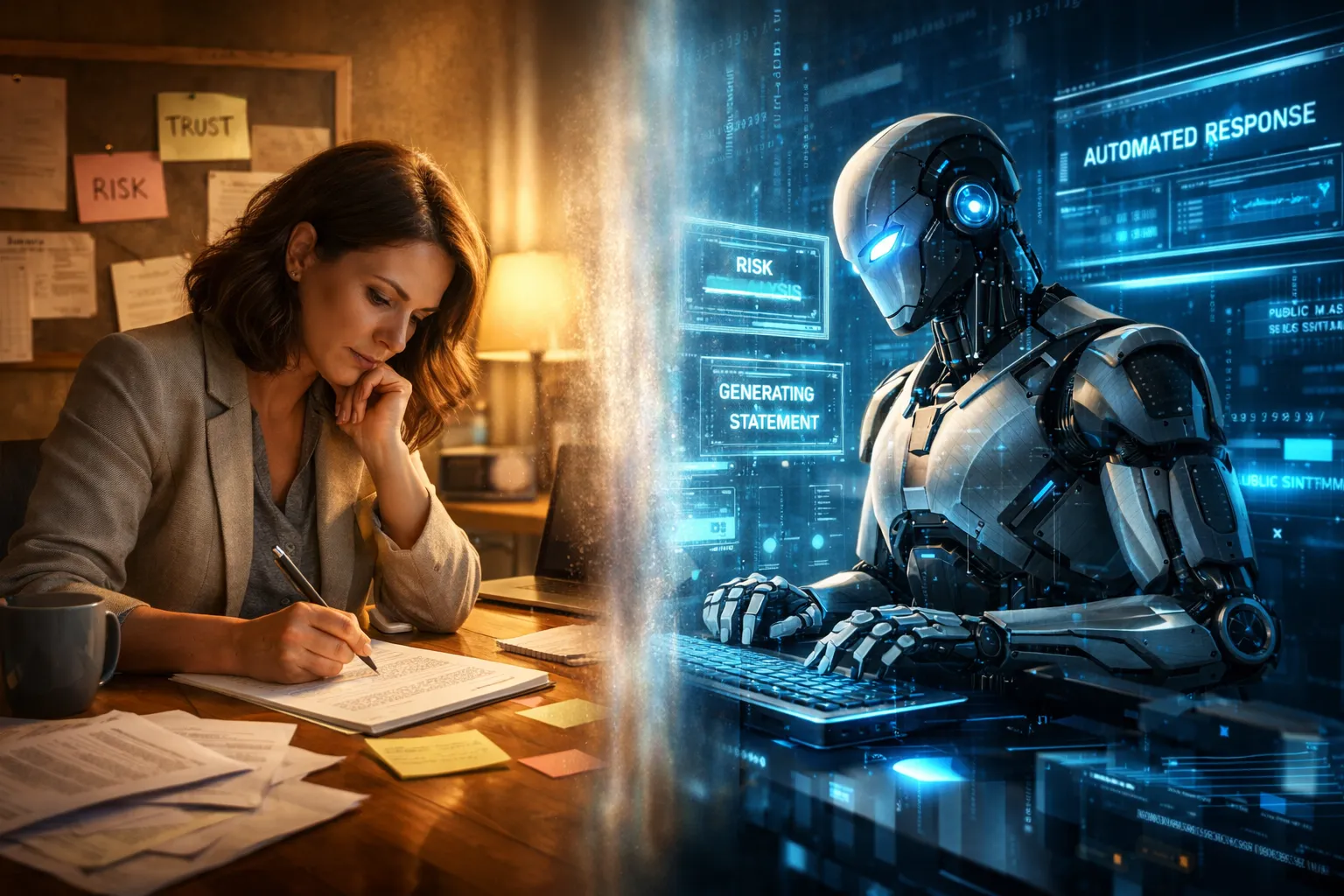
Three weeks ago, a thread in r/PublicRelations made my blood run cold. A crisis comms manager posted about using ChatGPT to draft a holding statement for a data breach affecting 340,000 customers. The AI-generated response was fast, professional-sounding, and completely wrong. It promised "immediate notification to all affected individuals" when the legal team hadn't even finished identifying who was impacted. It used the phrase "we take security seriously" three times. And it included a technical explanation of the breach that contradicted what the cybersecurity firm had actually found.
The statement went out before anyone caught the errors. The company had to issue a correction four hours later, which made the crisis exponentially worse. Customers who were already angry about the breach now didn't trust anything the company said.
Forty-seven comments on that thread, and the split was fascinating. Half the respondents said "This is why you never let AI touch crisis statements." The other half said "This is why you don't use AI without review, not why you don't use it at all."
That debate is happening in every crisis comms team right now. In 2026, the pressure to respond faster has never been higher. AI can draft statements in seconds that would take humans thirty minutes. But the cost of getting it wrong has also never been higher. When trust is already fragile and audiences are hypersensitive to corporate BS, an AI-generated misstep can turn a manageable crisis into a reputation disaster.
I've spent the past six months deep in LinkedIn groups, r/PublicRelations threads, and direct conversations with crisis comms leads across India, Southeast Asia, the US, and Europe. Everyone is trying to figure out the same thing: exactly how much AI should touch crisis communications before human judgment must take over.
This is the first comprehensive look at what the data actually shows, what's working in practice, and how to get the balance right.
The Productivity Gains Everyone Is Chasing
Let's start with why this conversation is happening at all. The efficiency gains from AI in crisis communications are genuinely compelling.
A crisis comms director at a fintech company in Mumbai walked me through her workflow. When a crisis breaks, she uses Claude or ChatGPT to generate three different versions of an initial holding statement in under two minutes. She reviews them, takes the strongest elements from each, adds human nuance, and has a solid draft ready for legal review in ten minutes instead of thirty.
For Q&A documents, the time savings are even more dramatic. She feeds the AI her crisis brief and asks it to generate twenty likely media questions with draft responses. It takes three minutes. Her team then spends forty-five minutes refining those responses instead of two hours creating them from scratch. Total time saved per crisis: about 90 minutes in the critical first few hours.
I'm hearing similar numbers across the board. Practitioners using AI for initial drafting report time savings ranging from 25% to 40% on routine crisis communication tasks like holding statements, internal announcements, and basic Q&A preparation.
The speed advantage is particularly valuable for global crises where you need statements in multiple languages simultaneously. AI translation combined with local market review can get you to market-appropriate responses in six languages within an hour. Doing that purely with human translators would take half a day minimum.
AI also excels at churning out multiple variations quickly. Need a statement for investors, employees, customers, and media? AI can generate tailored versions of the core message in minutes. A human still needs to review and adjust, but you're starting from 70% complete instead of zero.
For monitoring and analysis, AI is proving invaluable. Tools can now scan thousands of social media mentions, identify emerging narrative patterns, flag high-risk conversations, and surface the most critical issues for human review. One agency crisis lead told me his team went from manually reviewing 200 mentions per hour to AI-filtering 2,000 mentions and surfacing the 30 that actually require human attention.
These aren't theoretical gains. They're real productivity improvements that crisis teams are seeing right now in 2026.
The Dark Side: Trust Erosion and Error Risks
Now here's what keeps crisis practitioners up at night. Every productivity gain comes with serious risks that can backfire catastrophically.
Tone is the most common failure point. AI-generated crisis statements often sound like they were written by a corporate legal department and a PR agency having an argument. They're technically accurate but emotionally tone-deaf. They use phrases like "regret any inconvenience" when people are genuinely hurt or endangered. They hedge with corporate-speak when directness is required.
A healthcare crisis comms consultant described reviewing an AI-drafted apology for a medication error that had injured patients. The AI response was grammatically perfect and hit all the legal safe points. It was also completely devoid of genuine human empathy. She rewrote it from scratch because no amount of editing could fix the fundamental coldness.
Hallucinations are the scariest risk. AI will confidently generate plausible-sounding information that is completely fabricated. In crisis communications, this is catastrophic. I've seen AI draft statements that included regulatory compliance claims the company couldn't actually make, promised timelines that operations couldn't meet, and cited policies that didn't exist.
A corporate comms lead shared a near-miss where AI generated a statement about "industry-leading security protocols independently verified by [specific firm]." The verification had never happened. If that statement had gone out, the company would have faced potential fraud claims on top of their data breach crisis.
Context blindness is another major problem. AI doesn't know your organization's history, previous statements, or political sensitivities the way humans do. It will generate responses that directly contradict positions you took six months ago or that touch third-rail issues your leadership has explicitly said to avoid.
Cultural and regional missteps happen constantly. AI trained primarily on Western corporate communications doesn't naturally understand the communication norms, hierarchies, and sensitivities in Indian, Japanese, or Middle Eastern contexts. A statement that works for a US audience can be disastrous in Mumbai or Dubai without cultural adaptation that AI simply can't provide reliably.
The most insidious risk is subtle bias. AI can introduce gender, ethnic, or socioeconomic bias in ways humans don't immediately catch. In crisis situations where you're already under scrutiny, having your statement analyzed and found to contain unconscious bias becomes its own secondary crisis.
What the 2026 Risk Data Actually Shows
The numbers paint a concerning picture of rapid AI adoption without corresponding risk management maturity.
Research from the Institute for Public Relations published in early 2026 found that 67% of communications professionals are now using generative AI tools for some aspect of their work, up from 34% in mid-2024. But here's the gap: only 41% of those users have formal guidelines about when and how AI can be used in crisis situations.
Gartner's 2026 Crisis Communications Preparedness Study revealed that while 58% of organizations have adopted AI for drafting crisis responses, the mean preparedness score for managing AI-related risks in crisis communications is just 2.49 out of 5. Translation: most organizations are using AI without really understanding how to do it safely.
The productivity gains are real but modest in practice. The same Gartner research found that organizations using AI in crisis communications report a median productivity improvement of 28% for routine tasks, but only 12% for high-stakes, high-complexity crisis responses where human judgment is more critical.
The error rates are alarming. A study by the International Association for Measurement and Evaluation of Communication in late 2025 found that AI-drafted crisis statements reviewed by human experts contained factual errors or unsupported claims in 34% of cases when used without proper briefing and verification processes.
Trust erosion is measurable. Research from Edelman's 2026 Trust Barometer Special Report on AI in Communications found that 64% of communications professionals believe maintaining stakeholder trust has become more difficult since their organizations started using AI for external communications. When audiences discover that crisis responses were AI-generated, trust scores drop an average of 23 points on Edelman's 100-point scale.
The hallucination risk in high-stakes communication remains stubbornly high. OpenAI's own research acknowledges that even the latest models hallucinate in approximately 3% to 8% of outputs depending on the task. In crisis communications where you might generate dozens of pieces of content under pressure, that error rate is unacceptable.
Perhaps most concerning, the PRSA Crisis Communications Survey 2026 found that 71% of organizations have no formal process for verifying AI-generated crisis content before publication, and 82% provide no specific training on identifying AI hallucinations or errors in crisis contexts.
We're essentially running a massive uncontrolled experiment with organizational reputation as the stakes.
What Practitioners Are Actually Debating Right Now
The conversations in professional communities have evolved from "Should we use AI in crisis comms?" to "Exactly when is it safe versus when is it suicidal?"
The emerging consensus I'm seeing across communities is that AI is relatively safe for certain specific use cases but dangerous for others.
Safe zones that practitioners generally agree on: Initial draft generation for internal review (never for direct publication). Translation assistance with native speaker review. Q&A brainstorming to identify likely questions. Social media monitoring and sentiment analysis. Template-based routine updates where facts are pre-verified. Media list building and contact research. Timeline creation and factual chronology organization.
Danger zones where human control is considered non-negotiable: Final statement approval for any external audience. Apologies or expressions of empathy. Statements involving legal liability or regulatory compliance. Crisis communications involving death, injury, or serious harm. Responses to allegations of misconduct or wrongdoing. Communications with employees about layoffs, safety issues, or investigations. Any statement that could be used in litigation. Initial response to emerging crises where facts are still unclear.
The debates get heated around the middle ground. When is an AI-drafted holding statement acceptable if a human reviews it? How much editing transforms an AI draft into something that's really human-written? If AI generates three options and a human picks one and tweaks it, who's really authoring the message?
A recurring theme in LinkedIn discussions is the "AI-assisted versus AI-generated" distinction. Many practitioners are comfortable saying they use "AI-assisted" crisis communications but deeply uncomfortable with "AI-generated" messaging, even when the practical difference is minimal.
There's also fascinating debate about disclosure. Should crisis statements disclose when AI was used in drafting? Some argue transparency builds trust. Others say it introduces unnecessary doubt about message authenticity. Nobody has figured out the right answer yet.
A Practical Decision Framework for the Human-AI Balance
Based on what's working for practitioners, here's a framework you can use immediately when crisis hits.
The Five-Question Safety Check
Before using AI for any crisis communication task, ask these questions:
Question 1: Could an error in this content directly harm people, create legal liability, or cause irreversible reputation damage? If yes, human-only. No AI involvement beyond research assistance.
Question 2: Does this communication require demonstrating genuine empathy, accountability, or emotional intelligence? If yes, human must write the core message. AI can assist with formatting or translation but not core content.
Question 3: Do we have verified facts to feed the AI, or are we still in information-gathering mode? If facts aren't solid, don't use AI. It will hallucinate to fill gaps.
Question 4: Is this going directly to external audiences or through human review first? Never publish AI-generated crisis content without human review, full stop.
Question 5: Does the person reviewing the AI output have subject matter expertise to catch subtle errors, tone problems, or contextual mistakes? If the reviewer doesn't deeply understand the issue, they can't effectively review AI output.
The Task Categorization Model
Put every crisis communication task into one of four categories:
Category 1: AI-Forbidden (human only). Legal statements, apologies for serious harm, communications about deaths or injuries, responses to allegations, executive statements on sensitive matters.
Category 2: AI-Assisted (human leads, AI supports). Main crisis statements, stakeholder communications, media responses, employee updates. Human writes or heavily edits AI drafts.
Category 3: AI-Generated with Human Review (AI leads, human verifies). Holding statements, routine updates, FAQ documents, translated versions. AI drafts, human reviews thoroughly before use.
Category 4: AI-Appropriate (AI with light human oversight). Social monitoring, sentiment analysis, media list building, timeline organization, translation drafts.
Most crisis tasks fall into Categories 2 and 3. Very few belong in Category 4, and Category 1 is larger than most people think.
Real-World Patterns from Recent Crises
Let me share what's actually happened when organizations got this balance wrong or right.
A consumer goods company faced a product contamination crisis. Their comms team used AI to draft Q&As for the customer service team. The AI generated a response to "Is this product safe?" that said "The product meets all regulatory safety standards." Technically true for the uncontaminated batches, catastrophically misleading for the affected ones. Customer service agents gave that response to panicked customers who'd bought contaminated product. The resulting outrage and media coverage was worse than the contamination itself. The lesson: AI doesn't understand the difference between technically accurate and contextually honest.
A tech company experienced a data breach. They used AI to translate their crisis statement into eight languages simultaneously. The AI translation perfectly captured the English meaning but used an idiom in the Hindi version that implied the customers were at fault for the breach. Social media in India exploded. The company had to pull and retranslate within hours. The lesson: AI translation without native cultural review is playing with fire.
On the positive side, a financial services firm used AI brilliantly during a trading platform outage. AI monitored social media, flagged emerging complaints by severity, generated draft responses to common questions, and created a real-time FAQ that humans reviewed and approved in batches every 30 minutes. They responded to 4,000 customer inquiries in six hours with consistent, accurate messaging. The lesson: AI excels at scaling routine crisis responses when humans set clear parameters and review thoroughly.
A hospital system faced allegations of patient mistreatment. They wisely chose human-only for the public response but used AI to help organize the timeline of events, compile relevant policies, and structure their fact-gathering. This let their crisis team focus cognitive energy on crafting the message rather than organizing information. The statement was thoughtful, empathetic, and factually bulletproof. The lesson: AI as a research and organization assistant lets humans focus on high-judgment tasks.
What to Do This Quarter to Get the Balance Right
Stop improvising and formalize your approach immediately.
Create clear written guidelines about when AI can and cannot be used in crisis communications. Use the framework in this post as a starting point. Get legal, compliance, and senior communications leadership to approve it.
Train your team specifically on AI risks in crisis contexts. Not generic AI training. Specific exercises on identifying hallucinations, catching tone problems, and recognizing when human judgment is required. Run tabletop exercises where AI-generated content contains deliberate errors and see if your team catches them.
Implement a two-person review rule for any AI-assisted crisis content. The person who prompted the AI cannot be the only reviewer. Fresh eyes catch what the prompter misses.
Build prompt libraries for common crisis scenarios with strong safety instructions. "Draft a holding statement for a data breach. Do not make any claims about the scope of the breach, timeline for resolution, or regulatory compliance unless I specifically provide verified facts about these topics."
Establish verification protocols. Before any AI-generated crisis content goes out, someone must verify every factual claim, every timeline commitment, every policy reference. No exceptions.
Choose your tools carefully. Not all AI platforms are equal for crisis work. Some allow you to restrict training data, some provide better source citations, some are more prone to hallucinations. Test rigorously before you're in crisis mode.
Document everything. When you use AI in crisis communications, log it. What tool, what prompt, who reviewed, what changes were made. This creates accountability and helps you learn what works.
The Future Belongs to Teams Who Get This Right
Here's what I know after seventeen years in crisis communications and six months watching this AI transition unfold. The teams that will thrive are not the ones who reject AI entirely or embrace it uncritically. They're the ones who develop genuine expertise in using AI as a powerful tool while keeping human judgment firmly in control.
AI is making crisis communications faster and more scalable. That's valuable. But speed without accuracy is just faster failure. Productivity without trust is just efficient reputation destruction.
The organizations getting this right are treating AI like a very smart, very fast junior associate who needs constant supervision. You wouldn't let a junior associate draft and send a crisis statement without senior review. The same principle applies to AI, except the junior associate might confidently make up facts and won't feel bad about it.
We're still early in figuring out the optimal balance. The practitioners sharing hard-won lessons in communities, the teams running experiments and documenting results, the crisis leads building frameworks and training their people, those are the professionals writing the playbook everyone will use.
Get the balance right, and you have a genuine competitive advantage. Get it wrong, and you're one AI hallucination away from turning a crisis into a catastrophe.
The human element in crisis communications isn't disappearing. It's becoming more valuable, not less. But only for those who know exactly when and how to deploy it.