7 Common O-1A Media Coverage Mistakes to Avoid
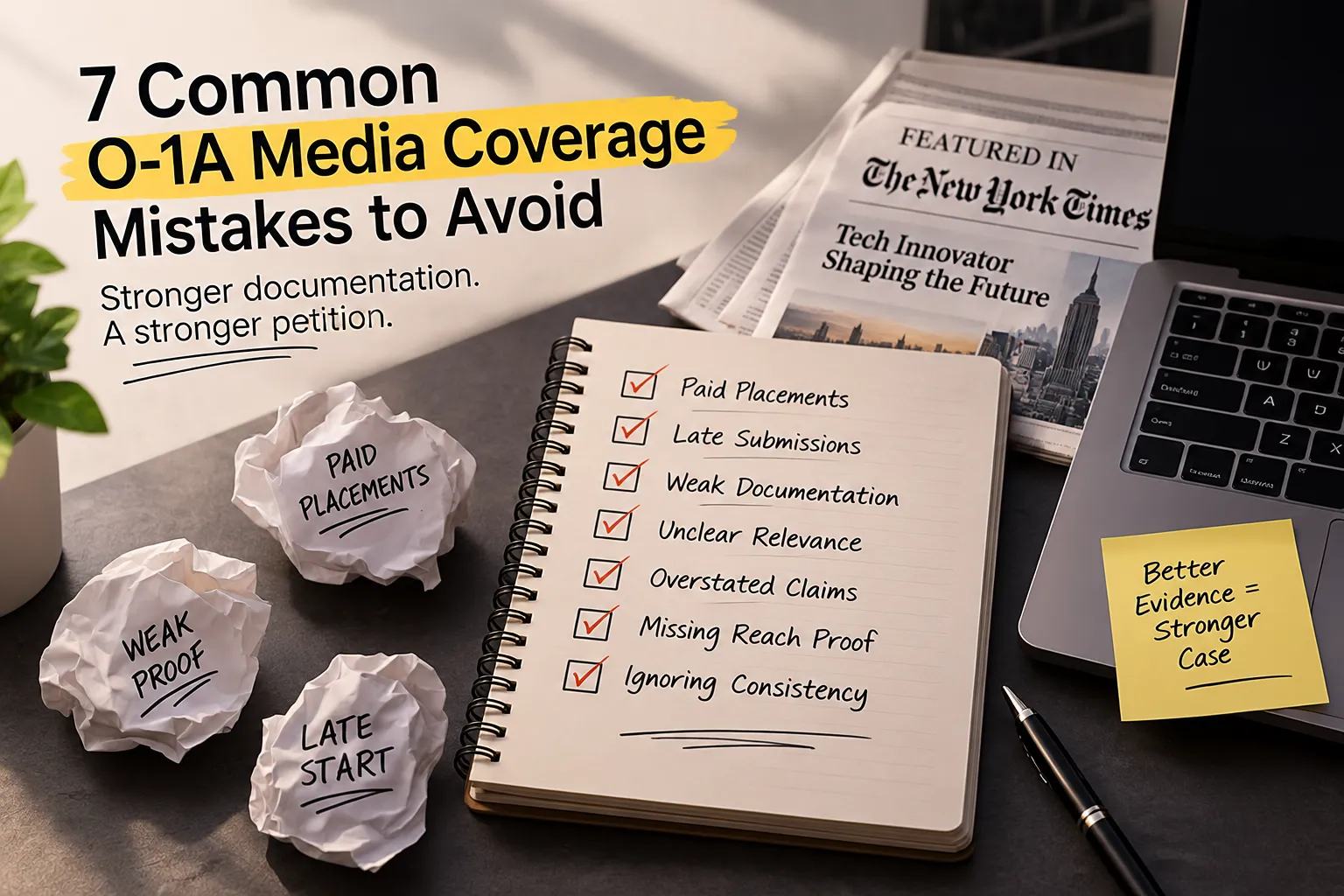
Most O-1A applicants who struggle with the published material category are not short of achievements. They make avoidable mistakes in how coverage is earned, chosen or presented. Some mistakes waste money. Others create doubts that spread to the rest of the petition.
The review climate makes this more important. The O-1 visa request for evidence rate was about 23% in the third quarter of fiscal year 2026, up from roughly 19% a year earlier. Here are the seven O-1A media coverage mistakes we see most often, why each one matters and how to avoid it.
Mistake 1: Starting Too Late
What happens: An applicant learns about the published material category a few weeks before filing and tries to compress months of media work into days.
Why it hurts: Earned coverage moves at the pace of editors. Features are planned weeks or months ahead, and every article must be published before the petition is filed. Rushing pushes applicants toward low-quality outlets or paid shortcuts.
The fix: Start six to twelve months before your target filing date. If time is short, focus on one or two credible trade publications rather than many weak placements.
Mistake 2: Paying for Placements That Look Like News
What happens: An applicant buys a "featured" article in a well-known outlet, often through a contributor network or a sponsored section.
Why it hurts: USCIS guidance states that marketing materials are not generally considered published material about the person. It adds that this "includes seemingly objective content about the person in major print publications that the person or the person's employer paid for", as set out in the USCIS Policy Manual. An officer who spots a sponsored label may start questioning everything else.
The fix: Keep media evidence editorial. If you have already paid for placements, tell your attorney so they can decide whether to leave them out.
Mistake 3: Chasing Volume Instead of Depth
What happens: An applicant collects dozens of brief mentions, listicles and syndicated copies and presents them as a large media footprint.
Why it hurts: There is no minimum number of articles, and officers judge quality, relevance and credibility. A long list of thin items can make the strong ones harder to find and invite the question of whether any of them are truly about you.
The fix: Good O-1A press coverage is about depth. Aim for a small number of substantial articles in credible outlets. Remove duplicates and syndicated copies of the same story.
Mistake 4: Coverage About the Company, Not You
What happens: A founder or executive submits funding announcements and product news in which they appear once, as a name.
Why it hurts: USCIS says published material should be about the person and "not just about the person's employer and the employer's work". Company news can help other categories, but on its own it is weak evidence that you are recognized.
The fix: Pitch stories built around your contribution: what you built, decided or discovered, and the result. A founder profile or an interview about your work does far more than a company press mention.
Mistake 5: Coverage Outside Your Claimed Field
What happens: An AI engineer submits lifestyle features, travel stories or general business commentary unrelated to their technical work.
Why it hurts: The rule asks for material relating to your work in the field for which classification is sought. Off-topic coverage does little to show recognition in that field, however popular the outlet.
The fix: Map each article to the field in your petition. Prefer respected trade publications in your industry over general media that does not discuss your expertise.
Mistake 6: Overstating Facts to Get Published
What happens: To win coverage, an applicant inflates user numbers, revenue, titles or awards, and the exaggeration ends up in print.
Why it hurts: Once published, the claim is part of the evidence. If it conflicts with tax records, employer letters or other documents, it damages credibility. Willful misrepresentation in an immigration filing can carry serious long-term consequences, well beyond a single denial. Public concern about EB-1A fraud shows how closely this area is watched, and the same scrutiny will apply to EB-1A media coverage if you later apply for a green card.
The fix: Give journalists only facts you can document. Keep a file of proof for every number in every pitch.
Mistake 7: Leaving Your Attorney Out Until the End
What happens: The applicant and a PR team run a media effort in isolation and hand the attorney a finished stack of articles.
Why it hurts: The attorney may want coverage that supports specific categories, such as original contributions or a critical role. By the end, there is no time to change direction, and some articles may not fit the legal strategy at all.
The fix: Share your plan with your attorney at the start and send each article as it is published. Your attorney decides how evidence is used. Your PR team should work around that strategy.
Quick Self-Check
| Question | If the answer is "no" |
|---|---|
| Is your filing date at least six months away? | Narrow the plan to a few credible outlets |
| Was every article chosen by an editor, not bought? | Flag paid items to your attorney |
| Does each article discuss your work in depth? | Pitch profiles or interviews |
| Is each article about the field in your petition? | Refocus on trade publications in your field |
| Can you document every fact in every article? | Correct the record before filing |
| Has your attorney seen your media plan? | Share it now |
If your existing media file needs a second look, Public Media Solution offers an independent review of your O-1A media file for discussion with your attorney.
Why These Mistakes Cost More Today
The O-1 category has never been busier. The State Department issued a record 20,015 O-1 visas in fiscal year 2025, and officers are asking for more documentation before approving. More applicants also means more paid "feature" offers aimed at them, many of them marketed as visa shortcuts.
In that climate, weak media evidence stands out. An officer who sees sponsored labels, off-topic articles or claims that do not match the rest of the file has an easy reason to ask for more. A clean, honest media file does the opposite. It makes the rest of the case easier to believe.
What to Do If You Have Already Made These Mistakes
Many applicants only learn these rules after they have already bought placements or collected weak coverage. It is usually fixable.
- Make a full list. Record every article, how it came about and whether you paid for it.
- Be open with your attorney. Share the list, including anything paid or exaggerated. Counsel needs the full picture to decide what to use.
- Correct the record. If an article contains an error you can document, ask the outlet for a correction.
- Set weak items aside. Thin or off-topic coverage does not have to go into the petition.
- Build forward. Use the time you have left to earn a few substantial, editorial pieces in outlets that matter in your field.
- Adjust your filing plan if needed. If the strongest evidence will take a few more months, discuss the trade-off with your attorney.
The goal is a smaller, stronger and fully honest media file. That is almost always better than a large file that invites questions.
Closing Thoughts
None of these seven mistakes requires special expertise to avoid. They require time, honesty and coordination. Start early, keep coverage editorial and relevant, put depth ahead of volume, stick to facts you can prove and keep your attorney involved from the first pitch.
Key Takeaways
- Start media work six to twelve months before filing.
- Paid content is generally not treated as published material about you.
- A few substantial articles are stronger than many brief mentions.
- Coverage should focus on you and your work in your claimed field.
- Overstated facts can damage credibility and carry serious consequences.
- Involve your attorney from the beginning.
FAQs
What is the most common O-1A media coverage mistake?
Starting too late. It drives most of the other mistakes, especially paid placements and weak outlets.
Can paid articles hurt an O-1A petition?
They usually add little value, and an obvious sponsored label can raise doubts about the rest of the file. Tell your attorney about any paid content.
Is it a mistake to use company press coverage?
Not if it discusses your role in depth. It is a mistake to rely on company news that mentions you only in passing.
What happens if an article contains an exaggerated claim?
It can conflict with other evidence and damage your credibility. Raise it with your attorney before filing.
Does a high O-1 visa approval rate mean media mistakes do not matter?
No. Approval rates reflect well-prepared petitions. Weak or misleading media evidence is a common reason for requests for evidence.
How can I check my existing coverage for these mistakes?
Run each article through the self-check table, then review the results with your attorney or a PR team experienced in O-1A evidence.
This article is for general information only and is not legal advice. Media coverage does not guarantee O-1A approval. Please consult a qualified US immigration attorney about your situation.
Sources Used