SEO vs AEO vs GEO vs SXO vs AIO: The Complete 2026 Playbook Every Marketer Needs

The Moment Everything Shifted
It was early 2024. I was sitting across from the marketing head of a mid-sized SaaS company: good product, solid team, decent domain authority. They'd been ranking page one for their core keywords for two years straight. Revenue had been climbing. Life was good.
Then, almost overnight, their traffic dropped 34%.
Nothing had changed on their end. No penalty, no technical issue, no competitor with a sudden burst of link building. What had changed was where their potential customers were asking questions. Instead of typing into Google and clicking through to their site, those users were getting answers directly from AI chat interfaces. The journey, the intent, the question, the consideration were now happening in ChatGPT, in Perplexity, in Google's AI Overviews. And this company's content wasn't showing up anywhere in that conversation.
That was my wake-up call. Not just theirs, mine.
I've been doing this since 2007. I was there when Google Panda shook content farms to their core. I was there through Penguin, Hummingbird, RankBrain, and Core Web Vitals. Every time, I watched marketers scramble to catch up while those who'd built on fundamentals held their ground. But this AI shift? This one's different in kind, not just in degree. Because for the first time in my career, the destination is changing, not just the path to get there.
So I sat down and built out what I now call the Optimization Stack, a layered framework that treats SEO, AEO, GEO, SXO, and AIO not as competing strategies but as five interlocking gears. Pull one out, and the machine slows. Run all five together, and you get compounding returns that none of them could deliver alone.
That's what this guide is about. Let's go deep.
Part 1: SEO, The Foundation That Never Retires

Definition and What It Actually Means in 2026
Everyone knows SEO. Search Engine Optimization. Rank on Google, get traffic, convert. But here's the thing most people get wrong: they treat SEO like it's a tactic when it's really an infrastructure layer. If your site doesn't crawl correctly, loads in 4 seconds, and has thin content, everything else I'm about to tell you is irrelevant. You're building on sand.
SEO in 2026 is still fundamentally about SERP visibility, but the SERP itself looks nothing like it did even three years ago. You've got AI Overviews at the top, featured snippets, People Also Ask carousels, local packs, video results, and then, buried somewhere below the fold, the traditional blue links. So while SEO remains the foundation, what you're optimizing for has expanded considerably.
How It Evolved and Why It Still Matters
Back in 2012, I was running link-building campaigns that would make any modern SEO specialist wince. We were buying links, spinning content, stuffing keywords into alt tags. It worked, briefly, until Penguin rolled out and I watched three client sites vanish from the index in a single afternoon. That experience taught me something I've never forgotten: sustainable SEO is built around the user, not the algorithm.
The algorithm changes. User intent doesn't , not fundamentally. People still want fast answers, trustworthy information, and pages that solve their specific problem. If your SEO strategy is built around serving that need genuinely, algorithm updates tend to help you, not hurt you.
In 2025-2026, the most important SEO signal isn't backlinks or keyword density. It's topical authority. Google's systems have become sophisticated enough to understand whether your site genuinely owns a subject area or is just producing content around it. The brands that are winning right now have built content ecosystems , pillar pages, supporting clusters, and interlinking structures that signal to both users and search engines: we are the definitive source on this topic.
The SEO Pillar Audit: My Core Checklist
After hundreds of site audits, here's the framework I always start with before touching anything else:
Technical Foundation (must pass before everything else)
- Core Web Vitals all green , LCP under 2.5s, CLS under 0.1, INP under 200ms
- Mobile-first rendering confirmed in Search Console
- Clean URL structure with logical hierarchy
- XML sitemap updated and submitted
- No orphan pages, no crawl depth beyond 4 clicks from homepage
Content Architecture
- At least one pillar page (2,000+ words) for each core topic cluster
- Supporting content addresses long-tail variations and related questions.
- Internal linking connects cluster to pillar consistently.
- No keyword cannibalization across pages
Authority Signals
- E-E-A-T signals present: author bios, credentials, citations
- Backlink profile is diverse and contextually relevant.
- Brand mentions (linked and unlinked) growing over time.
One client, an e-commerce brand in the home decor space, had decent rankings but stagnant organic revenue. When I ran this audit, I found they had 47 separate blog posts all targeting variations of "best living room furniture." Classic cannibalization. We consolidated them into one comprehensive guide, redirected the rest, built a proper cluster around it, and within four months they'd moved from position 7 to position 2 on their main term. Revenue from organic traffic up 41%.
Challenges and the AI Mix
The biggest challenge in SEO right now isn't technical; it's psychological. Marketers are panicking about AI Overviews eating their traffic and pivoting away from SEO entirely. That's a mistake. What the data actually shows is that queries with clear informational intent now get AI Overview treatment, but high-intent commercial and transactional queries still drive traditional clicks. Your job is to understand which of your keywords live in which category and optimize accordingly.
The trend to watch: AI-assisted content creation is now table stakes, but AI-generated content with no human editorial layer is getting increasingly penalized. Google is getting better at detecting it, and more importantly, users are getting better at ignoring it.
Part 2: AEO, The Art of Being the Answer

What AEO Actually Is (And Why Most Brands Ignore It Until It's Too Late)
Answer Engine Optimization. The goal is simple to state and surprisingly hard to execute: make your content the direct answer to a specific question. Not a page that might answer the question. The answer.
This is what powers featured snippets, People Also Ask boxes, and voice search responses. When someone asks their phone "what's the best way to clean a cast iron pan" and gets a spoken answer in 15 seconds without clicking anything, that answer came from somewhere. AEO is the discipline of making it come from you.
I started paying serious attention to AEO around 2019 when a client in the legal services space saw their featured snippet traffic account for more new leads than their entire email list that month. They weren't getting clicks; they were getting calls. People heard the snippet on voice search, remembered the brand name, and phoned directly. Zero-click, but not zero-conversion.
The Zero-Click Paradox
Here's the nuance most people miss: zero-click results feel like a loss; you answered the question, Google showed it, nobody visited your site. But in a trust economy, being the answer builds authority in ways that raw traffic doesn't. When your brand is consistently the source of correct, concise answers, you become the default. The brand someone thinks of when they eventually do want to go deeper.
The framework I use is what I call the Answer Architecture:
- Question Identification: Use tools like AlsoAsked, Answer The Public, and your own Search Console query data to find questions people are actually typing. Long-tail, conversational, specific.
- Format Matching: Different question types require different answer formats. "How to" questions want numbered steps. "What is" questions want concise definitions (40-60 words, max). "Best" questions want comparison tables or brief lists. Get the format wrong, and you won't win the snippet even if your answer is the most accurate one.
- Schema Markup , FAQ schema, HowTo schema, and speakable schema tell Google explicitly: this content is structured to answer questions. It's not a guarantee, but it dramatically increases your chances.
- Voice Optimization: Voice answers are typically 29 words on average (I've tracked this across my own client data). Write a summary paragraph for every major piece of content that would work read aloud in under 10 seconds. Natural language, complete sentences, includes the query term naturally.
AEO and the Interlink with SEO
AEO doesn't work in isolation. The pages that win snippets are almost always pages that already rank in the top 5 organically. Google is pulling answers from content it already trusts. So the interlink is direct: strong SEO gets you in the consideration set, strong AEO gets you selected. You need both.
The challenge , and I've seen this derail many well-intentioned optimization campaigns , is that AEO requires a different writing discipline than traditional SEO content. SEO content rewards depth, comprehensiveness, and link-earning. AEO rewards clarity, brevity, and precision. One client tried to pursue both simultaneously without a clear brief and ended up with hybrid content that did neither well. The fix was separating intent: long pillar pages for SEO authority, lean FAQ pages for AEO positioning. Worked beautifully once we stopped trying to do everything in one piece.
Part 3: GEO , Where AI Search Meets Local Reality

The New Frontier: Getting Found in Generative AI Results
Generative Engine Optimization is the newest pillar, and it's the one that's growing fastest. GEO means optimizing your content and your brand presence so that when someone asks an AI- ChatGPT, Perplexity, Google Gemini, or whatever emerges next- it surfaces you in its generated response.
This isn't hypothetical anymore. I watched it happen in real time with a regional dental clinic chain I was working with in late 2024. We started tracking how often their brand appeared in AI-generated responses to prompts like "best dental clinic in Pune" across major AI tools. Before we optimized: near zero. Six months into a focused GEO strategy: appearing in the top three AI-suggested options on every platform we tracked.
How GEO Works: The E-E-A-T and Entity Foundation
AI language models don't crawl the web fresh every time you ask a question. They synthesize information from their training data and, for tools with web access, from current indexed content. What they look for when generating recommendations or summaries is:
- Entity clarity: Is your brand, person, or business clearly defined as a distinct entity with consistent information across the web? Your Google Business Profile, Wikipedia mention (if applicable), LinkedIn, Crunchbase, industry directories- these all contribute to how AI models understand who you are.
- E-E-A-T signals: Experience, Expertise, Authoritativeness, Trustworthiness. This is Google's framework, but it's equally important for AI training. Content authored by credentialed experts, citing reputable sources, with verifiable claims, is what AI models learn to trust and surface.
- Longform, conversational content , AI tools often generate responses that feel like conversations. Content written in a natural, conversational register- not keyword-stuffed paragraphs, but genuine explanatory prose- tends to translate better into AI-generated summaries.
- Local signals: For local businesses especially, GEO and local SEO are deeply intertwined. Your Google Business Profile accuracy, the consistency of your NAP (name, address, phone) across directories, and the volume of genuine reviews all feed into AI's understanding of your local authority.
My GEO Implementation Framework: The "AI Visibility Audit"
I developed this after running a pilot program across eight clients in different verticals. Here's the five-step process:
Step 1: Entity Establishment: Search your brand name across Google, Bing, ChatGPT, and Perplexity. Document what appears. Is the information accurate? Consistent? Complete? Fix discrepancies across all citations.
Step 2: Knowledge Source Mapping: What third-party sources does AI typically cite about your industry? Trade publications, review sites, industry databases- identify the top ten and ensure your brand is represented accurately on each one.
Step 3: Conversational Content Creation: Write at least five pieces of long-form content that directly answer the questions your target audience is asking AI tools. Format them with clear headers, concise paragraphs, and embedded FAQs. These become training fodder for future AI model updates and current-retrieval sources for tools with live search.
Step 4: Review and Mention Velocity AI tools weight recency and frequency. A brand with 200 recent positive reviews across multiple platforms is more likely to surface than one with 20 reviews from three years ago. Build a systematic review-generation process.
Step 5: Track AI Mentions. Use tools like Brandwatch, Mention, or even manual weekly testing to track how often your brand appears in AI-generated responses to your target prompts. Set a baseline, track monthly, iterate.
Part 4: SXO , The Conversion Layer Everyone Underestimates

When Rankings Mean Nothing
Here's a story that still makes me a little embarrassed to tell. 2021. I had just delivered a glowing SEO report to a B2B software client. Rankings up across 23 target keywords. Organic traffic up 67% year-over-year. I was genuinely proud.
Then their CEO asked me one question: “Why is revenue flat?”
I looked at the data. Traffic was up, rankings were up, but bounce rate was 71%, average session duration was under 90 seconds, and the conversion rate from organic visitors was 0.3%. We were driving people to a site that wasn't ready to receive them.
That experience fundamentally changed how I structure every engagement. SEO without SXO is filling a leaky bucket.
What SXO Actually Encompasses
Search Experience Optimization is the discipline of ensuring that the experience after the click matches the promise of the search result. It covers:
- Page Speed and Core Web Vitals , not just for ranking signals, but because a 1-second delay in mobile load time can reduce conversions by up to 20%. I've seen this play out too many times to treat it as theoretical.
- UX Design and Information Architecture: Is the page easy to navigate? Does the user immediately understand what they can do here? Are CTAs visible without scrolling?
- Content-to-Intent Match: If someone clicks a link expecting a tutorial and lands on a product page, they'll bounce. Every page needs to fulfill the specific intent of every query it's targeting.
- Personalization: This is where SXO is heading in 2026. Heatmaps and session recordings are baseline. The leading edge is using behavioral data to serve different page experiences to first-time visitors versus returning ones, or to segment by referral source.
The SXO Optimization Loop
My approach is iterative and data-driven. Here's the six-week sprint model I use with clients:
Week 1-2: Baseline Data Collection. Deploy Hotjar (or equivalent), capture heatmaps, session recordings, and scroll depth on your top 10 landing pages. Don't make any changes yet; you need clean baseline data.
Week 3: Hypothesis Generation. Identify the three biggest friction points per page. Where are users dropping off? What CTAs are being ignored? Where does confusion seem to live? Write one specific hypothesis per friction point: "Moving the primary CTA above the fold will increase form submissions by X%."
Week 4-5: A/B Testing: Run controlled tests. One variable at a time. Don't change headline, button color, and page layout simultaneously; you'll never know what worked.
Week 6: Analysis and Iteration. Document results, implement winners, and start the next sprint with new hypotheses.
With the dental client I mentioned earlier, this process in three sprints moved their organic-to-appointment conversion rate from 1.1% to 4.3%. Same traffic, nearly four times the outcome.
SXO's Role in the Stack
SXO doesn't just improve conversions in isolation; it feeds SEO signals. Lower bounce rates, longer dwell time, more pages per session- these all signal to Google that your content is genuinely satisfying. It's a virtuous cycle: better experience leads to better engagement metrics, leads to better rankings, leads to more traffic, leads to more opportunities to convert.
Part 5: AIO, Building Content That AI Can Actually Use
The Emerging Discipline No One Fully Understands Yet
AI Optimization (AIO) is about making your content structurally and semantically ready for AI systems to read, understand, repurpose, and surface. It's the newest pillar, and honestly, it's the one where I'm still learning the most. But here's what I've figured out through client experiments and obsessive testing since 2023.
AI systems, both the ones crawling for training data and the ones doing real-time retrieval, have preferences. They prefer content that is:
- Semantically clean, Clear entity relationships, consistent terminology, no ambiguous pronouns where they could be replaced by the specific noun they reference.
- Well-structured HTML, Proper heading hierarchy (H1 → H2 → H3), no wall-of-text blocks, schema markup implemented correctly. AI reads structure as signal.
- Factually grounded , Claims supported by statistics, named sources, or verifiable examples. Vague assertions get deprioritized.
- Entity-rich , named concepts, people, places, products, and their relationships to each other. This is how knowledge graphs work, and AI systems trained on knowledge graphs respond well to entity-dense content.
The AIO Readiness Checklist
I run this against every new content piece before publication:
Structure Check
- Single H1 that contains the primary topic entity
- H2s that represent logical subtopics or questions
- Tables where comparative data exists
- Numbered lists for processes, unordered for features
- Summary paragraph (50-75 words) at top and bottom
Semantic Check
- Primary entity defined clearly within first 100 words
- Related entities mentioned naturally in context
- No ambiguous pronoun chains longer than 2 sentences
- Industry-standard terminology used consistently
Schema Check
- Article or Blog Posting schema with author entity
- FAQ schema for question-and-answer sections
- HowTo schema for process content
- Breadcrumb schema for navigation context
AI Accessibility Check
- Would a language model be able to summarize this in 3 sentences? (If no, it's too dense or too vague)
- Are all claims verifiable or sourced?
- Is the content format-agnostic? (Would it make sense to read aloud, as a table, or as a bullet list?)
The Human-AI Balance Challenge
Here's the hardest tension in AIO: AI-optimized content can start to feel robotic. Structured to the point of being sterile. I've seen this happen: we optimize a piece for AI readability and in the process strip out all the texture and voice that made it worth reading in the first place.
My solution is what I call the Voice-then-Structure approach. Write the first draft entirely in your natural voice, stories, asides, opinions, the works. Then, in editing, add the structural scaffolding: headers, schema markup, summary paragraphs. You get the human resonance and the machine readability. Never the other way around; if you start with structure, you'll end up with a template, not an article.
Part 6: The Optimization Stack Pyramid, How These Five Layers Interlock
The Model Most Marketers Are Missing
Here's what I want you to take away from this entire guide. These five disciplines- SEO, AEO, GEO, SXO, AIO- are not competitors. They're not even parallel tracks. They're a stack, and the order of the stack matters enormously.
Visualize it as a pyramid:
AIO
(top layer)
GEO + AEO
(middle layers)
SXO
(experience layer)
SEO
(foundation layer)
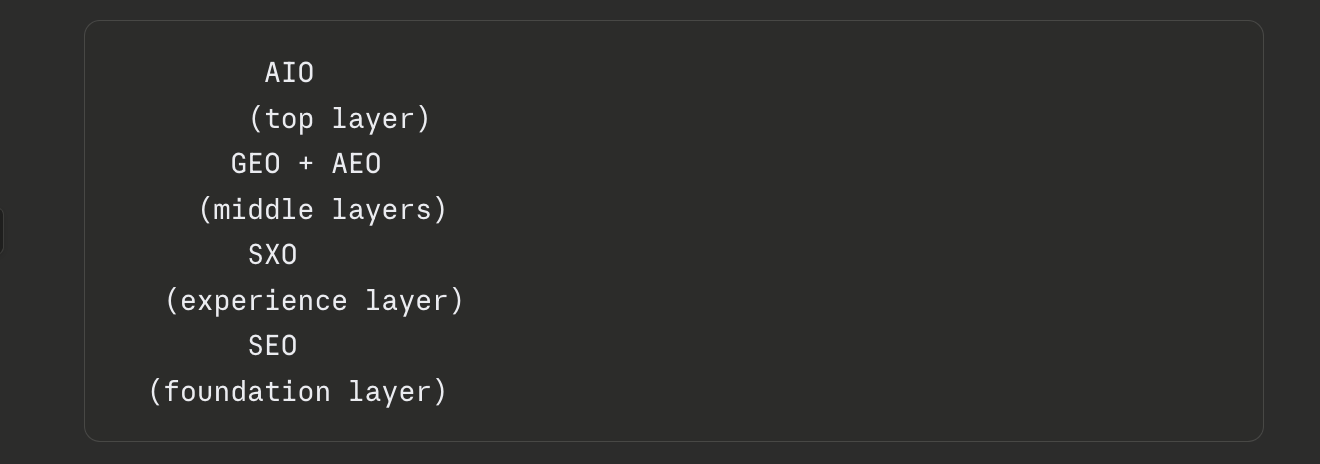
SEO is the foundation. Without it, nothing above it can function. Your site needs to be crawlable, trustworthy, and authoritative before any other optimization layer has a surface to build on.
SXO is the experience layer. It wraps the foundation and ensures that traffic arriving from any source- organic, AI-referred, direct- converts. A weak SXO layer means all the traffic you generate above it leaks out.
AEO and GEO are the middle layers. AEO captures intent at the moment of question. GEO captures presence in the AI-generated information environment. Both depend on the SEO foundation for credibility and the SXO layer for conversion when users do click through.
AIO is the top layer. It's the finishing coat , structuring your content so AI systems can read it, summarize it, and surface it in the formats that the middle and bottom layers depend on. AIO makes everything else more effective.
Pull any layer out, and the pyramid weakens. I've seen:
- Great SEO + no SXO = traffic without revenue (my 2021 story above)
- Great AEO + no SEO foundation = snippets that can't be sustained when Google re-evaluates trust signals
- Heavy GEO focus + no AIO = AI mentions that are vague or unsourced, building no lasting brand presence.
- Perfect AIO + no SXO = beautifully structured content that AI loves but humans bounce from
The game now is integration. Marketers who silo these disciplines , hiring an "SEO person," a "UX person," and an "AI content person" who never talk to each other , will watch their results plateau. The ones who build a unified optimization strategy across all five layers will compound.
Part 7: Measurement Across the Stack
Why Your Current Reporting Is Probably Lying to You
One of the biggest operational challenges in 2026 is attribution. Traditional SEO metrics (rankings, organic sessions, impressions) don't capture what's happening in the AI search layer at all. A brand can be thriving in GEO , being recommended constantly by AI tools , while showing flat organic traffic in Google Analytics, because the AI-influenced journey might end in a direct visit, a phone call, or a referral from someone who heard about you from an AI response.
My recommended measurement framework for the full stack:
SEO Layer Metrics
- Organic sessions, keyword rankings (tracked weekly)
- Click-through rate from Search Console
- Crawl coverage and Core Web Vitals health
AEO Layer Metrics
- Featured snippet wins tracked by keyword (monthly)
- Zero-click impression share in Search Console.
- Voice search query analysis (approximate, from long-tail data)
GEO Layer Metrics
- Manual AI mention testing across ChatGPT, Perplexity, Gemini (weekly)
- Review volume and sentiment trends
- Brand search volume in Google Trends
SXO Layer Metrics
- Conversion rate by landing page and traffic source
- Bounce rate and session duration for organic traffic specifically
- Goal completion rates (form fills, calls, purchases) by source
AIO Layer Metrics
- Schema markup coverage (via Search Console rich results report)
- Structured data errors (Google Rich Results Test)
- Content summary quality score (subjective test: can an AI summarize each piece accurately in 3 sentences?)
Part 8: The 2026-2027 Outlook
What's Coming and How to Get Ahead of It
The honest answer is: the acceleration is not slowing down. If anything, the next 18 months are going to be more disruptive than the last 18. Here's where I see things heading based on early signals:
Multimodal AI Search: Search is moving beyond text. Users are already uploading photos to ask visual questions. Voice queries are becoming more complex and conversational. If your content strategy is purely text-focused, you're going to start feeling that gap. Invest in image optimization, video transcripts, and structured data for visual content.
Agentic AI Browsing: AI agents that browse on behalf of users are going to change the definition of a "visit." An AI agent researching a purchase on behalf of a user doesn't behave like a human visitor. It prioritizes differently structured information. AIO becomes even more critical.
Trust Verification at Scale: Both Google and AI providers are investing heavily in distinguishing high-trust content from low-trust content. The brands that have built genuine E-E-A-T signals- real authors, real credentials, real external validation- will see that investment pay compounding dividends.
Personalized Search at the Query Level: Search results are becoming increasingly individualized. Two users asking the same question from different behavioral histories may see different results. SXO, already important, becomes essential as the entry point for every user is potentially different.
The Philosophy Behind the Stack
Seventeen years have taught me one thing more than anything else: the fundamentals compound and the shortcuts erode. Every marketer I've seen blow up a client's organic presence did it by chasing a tactic while neglecting a foundation. Every marketer I've seen build durable, growing organic revenue did it by layering genuine value , for users first, for search engines second, for AI systems third.
The Optimization Stack I've described here isn't complicated in concept. It's demanding in execution, because it requires discipline across multiple disciplines simultaneously. But the brands that commit to it , that build strong SEO foundations, that earn featured snippets through AEO, that show up in the AI conversation through GEO, that convert through SXO, and that structure their content for the AI-driven future through AIO , those are the brands that will not just survive the current disruption but genuinely pull away from competitors who are still arguing about whether AI search is “real.”
It's real. I've watched it happen in client accounts, in my own campaigns, in the way search behavior is shifting in real time. The question isn't whether to adapt , it's how fast and how comprehensively.
Start with an audit. Map your current stack. Find the weakest layer. Fix it. Move up. Repeat.
If you want to go deeper on any of this , or if you'd like me to run a proper Optimization Stack Audit on your site , subscribe to my newsletter where I share case studies, frameworks, and tactical breakdowns every two weeks. No fluff, no recycled blog summaries. Just what's actually working in client accounts right now.
And if this resonated with you, I'd love to hear where you are in your own stack-building journey. Drop a comment below or connect with me on LinkedIn. The most interesting conversations I have about this stuff happen there.
Let's build something that lasts.