The Foundation of AI Trust: Clean Code and Core Web Vitals in GEO | GEO Execution
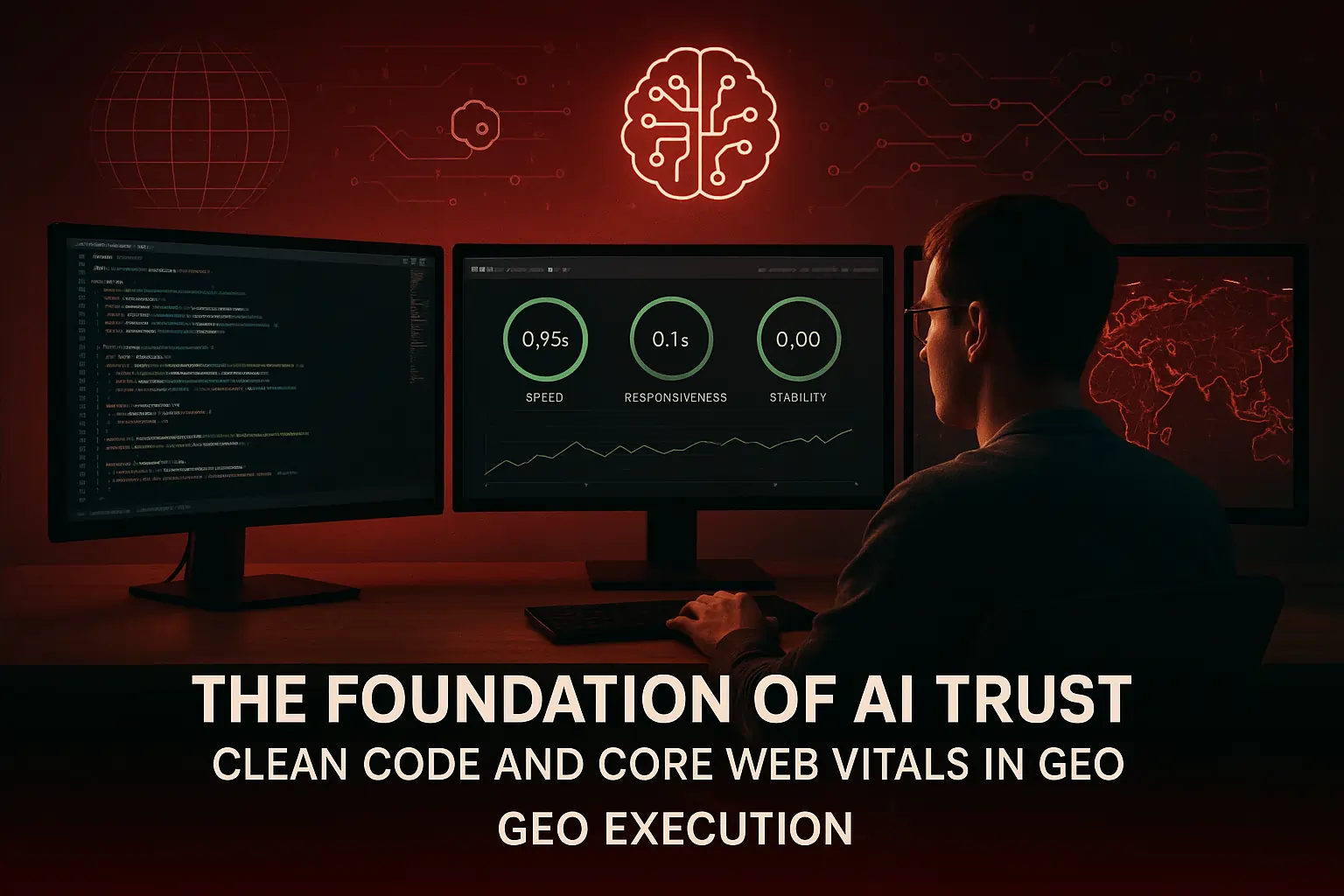
Are you noticing something strange happening with your website traffic lately? You're doing all the right things publishing great content, optimising for keywords but the number of clicks from search engines just isn't what it used to be. If this sounds familiar, you're not alone. The world of search is undergoing its most significant change in over a decade, and it's all because of Artificial Intelligence.
AI-powered search engines like ChatGPT, Google's AI Overviews, and Gemini are no longer just giving a list of links. They are providing direct answers to user questions. This is incredibly helpful for users, but it has created a massive challenge for businesses. Studies show that this shift is already causing a significant decrease in clicks to websites, with some reports indicating a drop of as much as 34%. Your customers are getting their answers without ever needing to visit your page.
In this new reality, the old rules of SEO are not enough. Ranking number one on Google is no longer the ultimate prize. The new goal is to become the trusted, authoritative source that the AI itself quotes and cites in its answers. This is the core principle behind a revolutionary new strategy we at Public Media Solution call Generative Engine Optimization (GEO).
But how do you become that trusted source? It's not just about having great content. It's about earning the AI's trust. And that trust, as we will explore, is built on a foundation that most marketers and business leaders completely overlook: the technical health of your website, specifically your code quality and your Core Web Vitals.
The New Rulebook: What is GEO and Why Does it Matter?
For years, the game was simple: get your website to the top of the search engine results page (SERP). We called this Search Engine Optimization, or SEO. But GEO is an entirely different ball game.
Think of it this way:
- Traditional SEO was like trying to get your newspaper advertisement on the front page. The goal was visibility, hoping someone would see it and decide to read it.
- Generative Engine Optimization (GEO) is like being the expert that the prime-time news anchor quotes directly on air. You are no longer just an option; you are the authority.
The primary goal of GEO is not to rank on a page, but to get your brand's information inside the AI's answer. When a user asks a question, we want the AI to say, "According to, the answer is..." This shift is critical because the competition is no longer just the other websites on page one. In the world of GEO, your competition is every single piece of data the AI has ever learned.
To win, you can't just be relevant; you must be seen as the most reliable, authoritative, and trustworthy source on a given topic. This brings us to the most critical question for any business in 2025.
The Million-Rupee Question: How Does an AI Decide Who to Trust?
Trust is the new currency of the digital world. For a technology to be accepted and used, it must be trusted. This is especially true for AI. An AI model's entire purpose is to provide helpful, accurate, and safe information. If it provides wrong, biased, or harmful answers, users will stop trusting it, and the entire system fails.
We've already seen what happens when AI trust breaks down. An Air Canada chatbot famously invented a refund policy that the airline was legally forced to honour, costing the company real money because the AI provided incorrect information. A delivery company's chatbot was tricked into swearing at a customer and criticising its own company. These failures are not just funny stories; they are serious business risks that highlight why AI systems are programmed to be incredibly careful about the sources they rely on.
So, how does an AI build this trust? It looks for a combination of signals that prove a source is credible and reliable. These include:
- Authority and Reputation: Does the brand have a substantial public presence? Is it mentioned in reputable media outlets and press releases? (This is where our expertise in PR becomes crucial).
- Expertise and Experience (E-E-A-T): Does the content demonstrate deep, first-hand knowledge on the subject? Is it written by credible authors?
- User Experience: How do real people interact with the website? Is it easy to use, fast, and stable?
While the first two points are well understood, it's the third one user experience that holds the hidden key to GEO success. An AI rightly assumes that if a website provides a poor experience for human users, its content cannot be fully trusted. And the most fundamental, measurable proof of a good user experience starts with two technical concepts: Clean Code and Core Web Vitals.
The Unseen Foundation: Why Clean Code is Your First Trust Signal
Most business owners never think about the code that runs their website. As long as the site looks good and works, that's all that matters, right? Not anymore. In the age of GEO, the quality of your website's code has become a direct and powerful signal of your brand's trustworthiness.
What is Clean Code? Let's Keep it Simple.
Imagine two kitchens in two different restaurants.
- Kitchen A is chaotic and messy. Ingredients are unlabelled, utensils are everywhere, and there's no clear system. Sometimes the food comes out great, but other times orders are wrong, delayed, or even give customers food poisoning. You can't trust the quality.
- Kitchen B is spotless and perfectly organised. Everything has its place, the chefs follow clear recipes, and the workflow is efficient. The food that comes out is consistently delicious, safe, and delivered on time. This kitchen has earned your trust.
Your website's code is its kitchen. Clean code is simply code that is written in a clean, organised, and simple way, just like Kitchen B. It is easy for developers to read, understand, and maintain. Messy, complicated code often called "dirty code" or "technical debt" is like Kitchen A. It might work for a while, but it's a breeding ground for bugs, security vulnerabilities, and slow performance.
How a "Clean Kitchen" Impresses the AI Health Inspector.
While your customers never see your website's code, they absolutely feel its effects. A website built with clean code is faster, more reliable, and has fewer frustrating errors. But more importantly, AI crawlers the bots that read and index your website for search engines act like a health inspector for your digital kitchen.
They can analyse the structure and quality of your site. A website built on a foundation of clean code sends several powerful trust signals to an AI:
- Reliability: Clean code has fewer bugs, which means the website is less likely to crash or behave unpredictably. An AI will always favour a stable source over an unreliable one.
- Security: Messy code can hide security flaws. AI systems are programmed to avoid sending users to potentially unsafe websites.
- Professionalism and Quality: A commitment to clean code is a signal that a brand cares about quality from the ground up. It shows a level of professionalism and attention to detail that extends to the content itself.
In the GEO era, your investment in high-quality development is no longer just an internal IT expense. It is a public-facing statement about your brand's commitment to quality and a foundational pillar of AI trust.
Your Website's Body Language: Core Web Vitals as Proof of Trust
If clean code is the organised kitchen, then Core Web Vitals (CWV) are the quality of the food and the speed of the service. They are the tangible experience your customer has, and they are the most direct way an AI can measure how trustworthy your website is in the real world.
Think about how you judge a person when you first meet them. Before they even say a word, their body language their posture, their eye contact gives you an instant impression of whether they are confident and trustworthy. A website does the same thing. Its "body language" is its performance, and Google has created three specific metrics to measure it: Core Web Vitals.
Decoding the Signals: LCP, INP, and CLS for Dummies.
You don't need to be a developer to understand what these metrics mean for your customers. They answer three straightforward, human questions:
- Largest Contentful Paint (LCP): How fast does it load? This measures how quickly the most crucial part of your page (like the main image or headline) appears. A good score is under 2.5 seconds. If it takes longer, your user gets impatient and feels like you are wasting their time. More than half of all users will abandon a page that takes more than 3 seconds to load.
- Interaction to Next Paint (INP): How quickly does it react? This measures how responsive your page is. When a user clicks a button or taps a link, how long does it take for something to happen? A good score is under 200 milliseconds. A delay makes the site feel broken, laggy, and untrustworthy.
- Cumulative Layout Shift (CLS): Does it jump around? This measures the visual stability of your page. Have you ever tried to tap a link, but right before you do, an ad loads and pushes the whole page down, causing you to tap the ad by mistake? That's a layout shift, and it's incredibly frustrating. A good score is close to zero (less than 0.1). A jumpy website feels unprofessional, cheap, and even deceptive.
Why a Happy User Makes for a Trusting AI.
These three metrics are not just technical numbers; they are direct measurements of human emotion. A poor CWV score translates to frustration, impatience, and annoyance. It breaks cognitive trust (the belief that your site works) and affective trust (the feeling that your brand cares about the user's experience).
AI systems and search engines monitor these signals very closely. When they see that users are quickly leaving your site (a high bounce rate) or not staying long, they interpret it as a clear sign of a low-quality, untrustworthy source.
The logic is simple and powerful: If real humans are having a bad experience on your website, why would an AI recommend your content or use it as a source for its answers?
It wouldn't. A strong Core Web Vitals score is one of the most compelling pieces of evidence you can provide to an AI that your brand is credible, professional, and worthy of being cited. It is the proof that you not only provide expert information but also deliver it in a high-quality, user-respecting package.
The Public Media Solution Advantage: Connecting PR, Code, and Citations
Understanding this deep connection between brand reputation, technical excellence, and AI trust is what sets Public Media Solution apart. We are proud to be India's First Truly Integrated PR + GEO Agency.
Other agencies see these as separate disciplines. They might have a PR team that builds your brand's story and a separate technical team that worries about website speed. This siloed approach no longer works. In the age of AI, your brand's story and your website's performance are two sides of the same coin: Trust.
Our proprietary GEO framework is built on this holistic understanding.
- We start by mapping your path to authority, identifying the key topics your brand must own.
- We use our deep media relationships and PR expertise to build powerful trust signals through high-authority brand mentions and articles.
- Simultaneously, we ensure your digital foundation is flawless. We work to structure your content in AI-friendly formats, implement advanced schema, and obsess over the clean code and Core Web Vitals that prove your reliability to both users and AI systems.
We connect the dots that others miss, building a complete "trust stack" for your brand—from the quality of your developer's code all the way to your citation in an AI's answer.
In the age of AI, trust is not just a feeling; it's a technical standard. Is your brand ready to meet it?