Google Business Profile for Clinics: The Local SEO Checklist Doctors Miss
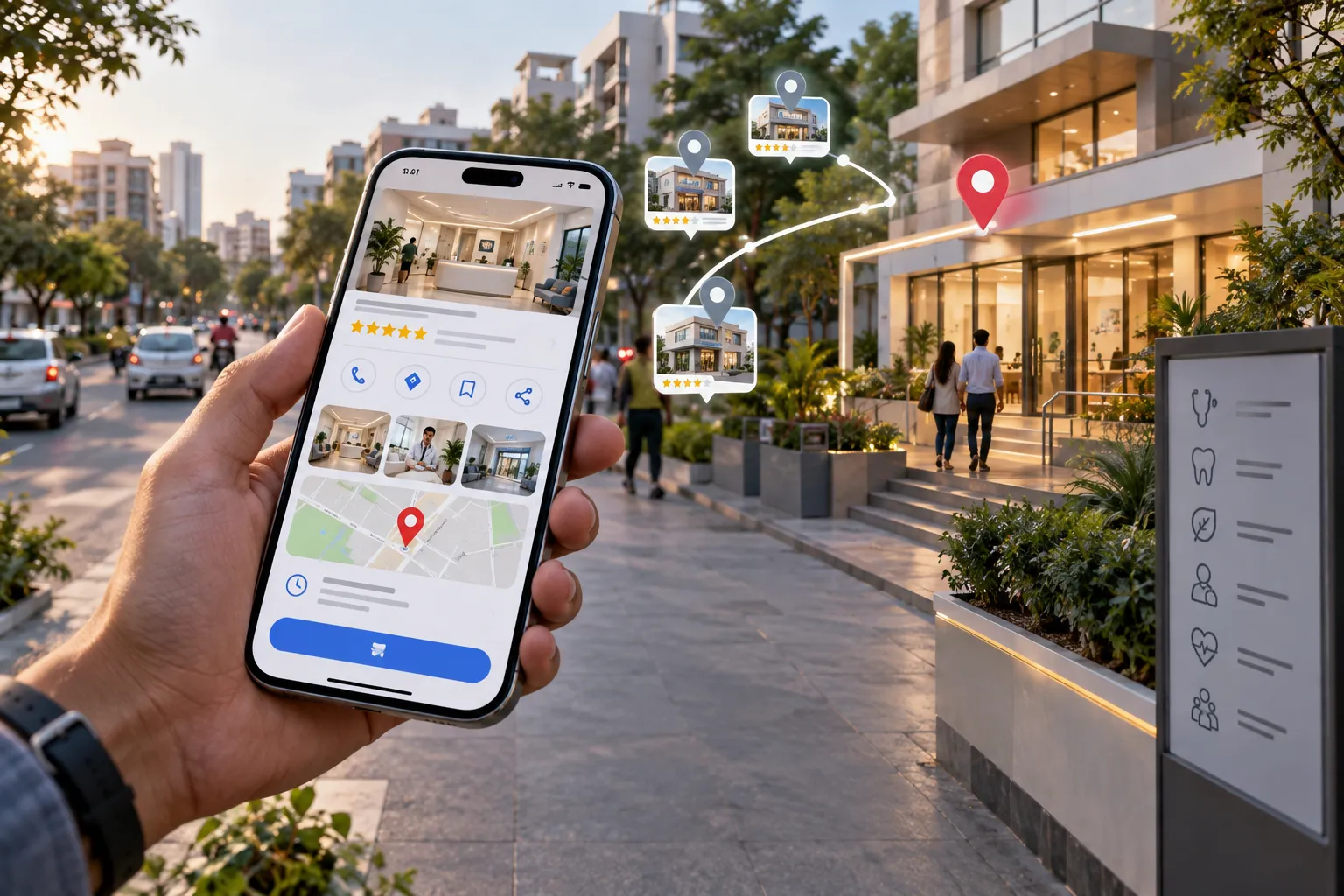
For a local clinic, Google Business Profile is the highest-ROI digital channel there is — and also the one most often set up once and forgotten. The gap between a basic listing and a fully-optimised one is the gap between being found and being invisible for every “near me” search in your area.
Here's the practical checklist — including the details doctors and clinic managers most often miss.
Why Google Business Profile Matters More Than Your Website
When a patient searches “dermatologist near me” or “child specialist in [area],” Google shows the Map Pack — three local listings — above the organic results. Most local clicks go there. For clinics, that makes your Google Business Profile the front door most patients walk through first. And unlike broad clinical AI Overviews, local provider queries remain largely AI-free, which keeps GBP the primary local visibility channel for the foreseeable future.
The Checklist Most Clinics Miss
1. Primary category precision
Your primary category is one of the strongest ranking signals. “Medical clinic” is weaker than the specific “Dermatologist,” “Pediatrician,” or “Dental clinic.” Choose the most specific primary category that fits, then add relevant secondary categories. Most clinics leave ranking power on the table here.
2. NAP consistency everywhere
Name, Address, and Phone number must be identical across your GBP, website, Practo, and every directory. Inconsistencies — a different suite number here, an old phone there — confuse Google and quietly suppress local ranking. This is the most common invisible problem.
3. Reviews — and responses
Review count, rating, recency, and your responses all feed local ranking and patient trust. A consent-based post-visit review request and a habit of responding to every review within about 24 hours is the highest-impact ongoing GBP activity a clinic can do.
4. Photos — real and regular
Listings with genuine, current photos of the clinic, reception, and equipment earn more clicks and calls. Interestingly, image-rich medical content also faces less AI competition than text. Add photos regularly, not once.
5. Google Posts
Most clinics never use Posts — the updates, health tips, and announcements that appear on your profile. Regular posting signals an active, cared-for practice and gives patients fresh reasons to choose you. It's free visibility most competitors ignore.
6. Services and attributes
Fully populate your services list and attributes (wheelchair access, online appointments, languages spoken, payment options). These help you match more specific searches and answer the practical questions patients filter on.
7. Q&A section — seed it yourself
The GBP Q&A is public and often ignored, so it fills with random questions. Seed it with the real questions patients ask — answered clearly — so you control that information and capture question-based searches. This pairs naturally with a broader FAQ strategy.
8. Appointment and messaging links
Add direct booking and messaging links so an interested patient can act in one tap. Every extra step between interest and contact loses patients.
Compliance Note for Indian Clinics
Everything above is factual and permitted — categories, photos, services, honest reviews. Where clinics get into trouble is stuffing the business description or Posts with prohibited superlatives (“best clinic,” “100% results”) or outcome guarantees. Keep GBP content factual and educational and you stay firmly within NMC, ASCI, and DMR Act boundaries.
A Simple Monthly GBP Routine
- Request reviews from satisfied patients (consent-based) and respond to all new ones.
- Add 3–5 fresh photos.
- Publish 2–4 Google Posts (health tips, updates, awareness days).
- Answer any new Q&A entries; add a seeded question or two.
- Re-check NAP and services for accuracy.
Fifteen minutes a week on this routine outperforms most paid campaigns a small clinic could run.
Related Reading & PMS Services
Explore the connected services and guides that put this into practice:
- Healthcare SEO Services — search visibility built for medical websites
- Healthcare Marketing — our full healthcare marketing practice
- Why Patients Choose One Hospital Over Another Online — the data behind online patient decisions
- Hospital Marketing in Delhi NCR: What Drives Patient Inquiries — the city-specific companion to this guide
- AI-Optimized FAQ Strategy — turn patient questions into citable answers
- Doctor Personal Branding on LinkedIn — building physician authority the compliant way
Frequently Asked Questions
How long does it take for GBP optimisation to work?
Category, NAP, and profile fixes can influence local ranking within a few weeks. Reviews and ongoing activity compound over 60–90 days. It's one of the faster-moving channels in healthcare marketing.
Can one clinic have multiple Google Business Profiles?
Only for genuinely separate locations, each with a distinct address and phone. Duplicate listings for the same location violate Google's guidelines and hurt ranking. Multi-location groups need one optimised profile per site.
Is GBP affected by AI search?
Local provider queries have stayed largely free of AI Overviews, so GBP remains the primary local visibility channel. Broad clinical questions do trigger AI answers — which is where content and AEO strategy come in alongside GBP.
Disclaimer: This article is general educational guidance for healthcare marketing leaders in India and is not legal advice. Medical advertising in India is regulated by the NMC, ASCI, and the Drugs & Magic Remedies (Objectionable Advertisements) Act 1954; specific creative should be reviewed against these before publishing. Figures cited are 2025–26 industry estimates and shift over time.